

President’s blog – May Newsletter 2026
So I’m writing this on the way home from Birmingham where, like many others, I’ve been at the inaugural RCEM Annual Conference, and I am feeling both tired and happy.
You may be aware that this was a transition from a conference programme where we held a CPD orientated event in the Spring, and a research orientated event in the Autumn … and moved to a single conference combining both.
This was a bit of leap into the unknown and we were pretty nervous. It meant we had to book a larger venue than we would normally, and represented another gear for both the events team and the conference committee. The programme was much broader in its scope, with the usual complexity around timings and room allocation. And there was experimentation around, for instance, the nature of some of the sessions. We had “budgeted” for 500 attendees. We got 1300 delegates from across the UK and around the world, plus another 800 online. That was a better problem to have than empty rooms.
So how did it go?
At the time of writing we haven’t received the formal written Feedback. So this blog is based on my own observations, conversations with delegates, and initial discussions with other colleagues from RCEM who have also been gathering feedback.
First of all: the vibe. I think this is the most important thing of all, and it felt right. There was definitely a buzz, there was lots of positivity about our speciality and what we can do, and lots of connection and reconnection between colleagues. It didn’t feel stale or fuddy-duddy.
There was a good cross section of people, mainly doctors and ACPs, and at all career stages. They were exposed to some really high-quality education, delivered across four tracks over three days.
We were delighted to host our Patron, HRH Princess Anne, who met a group of delegates, learned about the top poster submissions from the authors, attended the David Williams lecture, and presented the Rod Little prize. She travelled from London just for this event, and seemed both relaxed and interested to meet our people.
We also hosted the Secretary of State for Health and Social Care, Wes Streeting, who gave a speech and then took questions from the membership for some 20 minutes. It’s fair to say that our Vice President of Membership, Dr Salwa Malik earned a lot of kudos for her adept handling of the Q&A.
There was plenty of inspiration to be had, whether it was our keynote speakers at the top of their game, or from seeing colleagues at the start of their careers step up to tell us what they had been up to.
Having everyone in one place allowed for conversations and space to catch-up with each other. There were receptions around the city of Birmingham, yoga session, walking tours, and a morning run. And finally: the programme. So much good stuff and genuine praise for the various speakers, a record number of poster presenters and other facilitators. There were mock OSCE stations, silent seminars, medical escape rooms, and demonstrations of procedures. On the whole it ran like clockwork.
The conference had a number of objectives.
- Reinvent our conference offer. Tick
- Provide an excellent experience both in terms of CPD and in terms of academic emergency medicine. Tick
- Bring us together to connect with our “tribe” in a way that reflects our modern, dynamic, diverse and non-hierarchical speciality. Tick
- Provide a foundation on which to build for the future. Tick
I can’t talk about the conference without thanking the people who have put so much effort into making it a success. This includes the conference organisers, the RCEM events team, the wider RCEM team who contributed, and all the speakers and presenters. Thanks too to the sponsors who contributed to this event and showcased the latest innovations. What an exceptional effort by everyone and thank you so much.
So: next year Team Manchester, haven’t got too much to live up to…(!) Look out for more information in the months ahead.
President’s blog – April Newsletter 2026
Last month, I went to parliament to appear before the Health and Social Care Committee in a session on “corridor care.” The role of this cross-party group is to scrutinise the work of the Department of Health and Social Care and its associated public bodies. They examine government policy, spending and administration on behalf of the electorate and the House of Commons.
I appeared on a panel alongside Dr Rosie Benneyworth, the CEO of the Health Services Safety Investigation Body, and Professor Nicola Ranger, the Chief Nursing Officer of the Royal College of Nursing. Our role was basically to act as expert witnesses.
The hearing was televised and you can watch a recording here. The comms team also put together a short clip, and you can find that here.
Appearing before the committee was an opportunity to draw together some of the most recent evidence around corridor care, and to consolidate our thinking on the matter. This applies across the four nations. I thought it might be useful to summarise some of it for you. So, this blog is basically an update on crowding.
The hearing was partly in response to a report from the HSSIB into corridor care and this report was referenced first. It largely focused on the experiences of patients and staff, and discussed the balance between trying to mitigate the harm from corridor care, and normalising it by doing so. Of course this is something we’ve always been aware of. Our message on this was that “corridor care” is a visible symptom of overcrowding, and overcrowding is both a national issue and a national crisis. I stated that there is no safe or acceptable way to provide care in non-designated treatment areas. But I also argued that it isn’t inevitable and must not be normalised.
RCEM and other international emergency medicine organisations have been engaged in advocacy around ED crowding for years. RCEM’s most recent guidance was updated in 2024. The IFEM Task Force publication is also of interest to those wanting an overview of some of the science. We know from routine data that overcrowding is endemic across the four nations, and the extent of treatment in escalation spaces was also recently demonstrated by the TERN UNCORKED study. There is also solid, published UK data demonstrating the link between mortality and long waits for admission in our EDs. Click here for links to the Jones et al and Howlett et al papers. So we are on a strong footing now, in that we can back the narrative with evidence, and translate that into conservative estimates of excess deaths associated with long waits in our EDs. What that data doesn’t tell us is the extent of the associated non-fatal harm to both patients and staff, but at the hearing we were able to present up to date information and testimony from a survey of clinical leads. This was a powerful tool to help paint the picture, reinforcing recent reports from both the RCN and Age UK.
At times it feels like the debate has finally started to move on from whether overcrowding is a problem, and a good or bad thing … to how to fix it. Unbelievable as it is, that is the journey we have had to bring health service leaders and politicians on.
But how do we fix it? Well there isn’t one magic bullet, and that’s part of the problem. We can’t offer politicians a simple answer. Crowding is a whole system flow issue. From an EM perspective we know that it is possible to divide interventions into those aimed at input, throughout, and output ... so I’ll use that as a reference. But ultimately it will come down to output: exit block.
In each of the four nations the policy focus was first on throughput (e.g. how EDs operate). We have been at the centre of seemingly endless ideas as to how we might undertake our role better, and in the hope that we can do it with less. Deep breath required. We know how to do our jobs! We are, after all, specialists. RCEM has consistently advocated that our EDs need to be appropriately resourced in order to do what we are here for. This means having the right space, staff and stuff. And it means them not being crowded. Whilst EM has benefitted from some half-hearted investment, in the absence of improving the external environment, the potential for step changes is undoubtedly limited. This is starting to sink in, and attention is starting to drift elsewhere.
Input (e.g. demand management) has also been a consistent policy focus. More recently, it has become obvious that despite the introduction of a confusing array of options for patients, many of which are underpowered or aren’t available when needed, we are really feeling the side effects of the problems in primary care, and of failure to adequately commission services that can provide for patients with low acuity urgent care needs, particularly for “minor illness.” We are picking up the slack. We should only be doing our work, not everybody else’s. We are arguing that it’s time to sort this out, and that we can’t do everything.
Meanwhile output (e.g. access to alternatives to admission or beds) has been less emphasised. It’s harder, and more expensive. But probably not as expensive as everyone thinks given the cost of the current chaos. RCEM continues to believe that the prime driver of overcrowding in EDs is patients who are waiting for admission to a bed, and that this needs at least as much focus as everything else. To do that beds need to be available when patients need them.
Bed availability is driven by hospital occupancy. The true optimum hospital occupancy target is not known. RCEM recommends 85%, NHSE uses 92%, and we run at 95%+. Specialist wards, single sex requirements, side room availability, and hospital size will all influence the true requirement. But it’s all semantics if our hospitals are essentially full.
Importantly, improving bed availability / reducing occupancy isn’t just about putting in more physical beds, although the UK has the one of the lowest number of beds per head of population than most comparator countries.
- Many patients still get into beds who could have been dealt with differently. Alternatives to admission such as medical SDEC, frailty services, and “hospital at home” are ramping up and clearly have a role, and there is still opportunity here because they aren’t reliably available “out of hours” or close early because they are “at capacity.”
- Hospitals work inefficiently, partly driven by professional cultures and working practices. Our beds are not used effectively.
- Patients occupy beds they don’t need because they are waiting for social or community care. This is probably the biggest opportunity.
- We now know that several thousand beds across the UK are occupied by patients who wouldn’t have needed them if they hadn’t had a long wait in the ED in the first place (ref).
RCEM has been hammering on, pointing out the obvious we are overcrowded, the system is killing patients and breaking staff, and it’s all about exit block. National governments have for years been trying to avoid that reality. Now they are starting to say: “OK so maybe we believe you that our hospitals are full, the system is killing patients and staff are breaking, but do we really need more actual beds to make it better? Can't we get by just by working smarter? Then we wouldn’t need to make the investment.”
And so it continues. Governments are still driving hard on everything except fixing community and social care, and inpatient bed numbers. They are focusing on access to primary care, redirection, attendance and admission avoidance. I think we have run out of acronyms for different forms of demand management. In England GIRFT are going for organisational culture and ownership, and this is good. There are many cases where a change in culture and drive has led to improvements in ED crowding. It will be interesting to see what impact, and how sustainable, that program can have. But eventually we will get to a stage when it becomes apparent, even to those who control the money, that social care needs both reform and investment, and that we are also short of actual, physical, beds. My opinion is that if societal expectations remain unchanged, and demographic trends continue, that is the inevitable endpoint.
I would love this appearance before the Health Select Committee to be my first and last talking about the crisis in our EDs, because then it would mean things are getting better. I suspect it won’t be. Until our leaders show the courage to face up to reality and deal with the root causes of crowding. long waits, and corridor care, we will continue to stutter along. The evidence will mount, and eventually we will be called on to help pull our politicians’ heads a little bit further out of the sand. In the meantime we’ll keep battling on and representing you.
President's Blog - March 2026
The term “corridor care” has been picked up as a public and media friendly way of describing ED overcrowding. In this regard it has proved extremely useful as a hook. But has it become a victim of its own success or is it still a powerful way to focus attention on a problem which continues to claim lives, and which negatively impacts on everyone who experiences or works within emergency care.
“Corridor care” is not a recognised scientific or operational term. From an ED perspective: ED overcrowding (or more correctly, crowding) is the issue. Long waits are one effect of crowding and have a hard association with mortality. Corridor care describes a visible symptom of crowding, and will almost invariably be associated with long waits.
The notion of providing patient care in unsuitable spaces is intrinsically problematical, given the reality of trying to do it and the risk of normalisation of the unacceptable. This was well demonstrated in 2024 when NHS England produced guidance with the oxymoronic title “Principles for Providing Safe and Good Quality Care in Temporary Escalation Spaces”. Whilst acknowledging this guidance was well intentioned, RCEM got noisy about the obvious flaw. The guidance has now been renamed “Principles for providing care in corridors.” I did feel a familiar sense of despair, however, when I noted that contained within is the bizarre statement “Corridor care areas must uphold the same high standards of care for patients as those in planned clinical non-corridor settings.” We can’t provide decent care in corridors, and it is likely, although not yet proven, that trying to look after patients in corridors actively harms patients. We need to see the back of it.
This said: it may be that the term “escalation space” better describes all the places patients end up when our departments are full. We don’t just put our patients in corridors when we run out of space. We put them in spaces designed for assessment and rapid turnaround of patients, in converted cupboards and store-rooms, on chairs in waiting rooms, or in ambulances. It may be that by making the focus on patients in corridors, other patients who are also coming to harm will be forgotten.
Recently the RCEM Trainee Emergency Research Network published their superb UNCORKED study: which managed to count the number of patients experiencing care in escalation spaces across the UK. It wasn’t easy to do, and probably underestimated the problem because of the difficulties associated with definitions. But they did show that 17.7% of our patients were in escalation spaces at any one time. The team are currently undertaking a secondary analysis and we look forward to seeing the results of that.
However, although the term escalation space may be more correct, the movement to end “corridor care” seems to have gathered a life of its own. For example, in England the unimpressive 2025 Urgent and Emergency Care Plan talked about progress on eliminating corridor care. The Secretary of State for Health and Social Care doubled down and promised to eliminate corridor care by the end of the next parliament. That was a bold, and welcome, step. So far it hasn’t been backed up by bold action. But assuming that it’s best to take the opportunity presented and get behind efforts to make a dent in the crowding, what next?
If a political promise is made to fix a problem, then the problem will need to be measured. That means a definition, and the method should be amenable to automatic data extraction from existing computer systems. But then we know what happens: if something is counted, and there’s pressure on organisations to meet a target, there will be “gaming.” It seems that this is a tolerated part of NHS management culture, without accountability or consequences. And finally: how will counting patients in corridors translate into an improvement in the key outcomes associated with ED crowding, those of patient safety and staff wellbeing?
Fixing crowding would eliminate corridor care. Fixing long waits would also eliminate corridor care in most departments. Fixing either would improve outcomes.
There is currently no evidence that any measure of corridor care will act as a reliable proxy for long waits or ED crowding. That may come. It will be complicated to do. We can expect debates on thresholds and “when is a corridor not a corridor." It could be argued that if we need an existing validated metric for crowding, with evidence behind it, we already have at least one. Consider the 4-hour standard. We already measure it, everywhere, and it is linked directly to occupancy measures, and outcomes. If we were to go back to hitting the 4-hour standard, particularly for admitted patients, we would fix crowding. Our corridors, along with all the other hiding places for patients, would be empty.
The politics means that we are about to see the introduction of an unvalidated metric, to act as a proxy to drive progress towards fixing a problem that has been suffering from a lack of consistent commitment and focus from our politicians and health service leaders across all four nations. We will, I am sure, adapt and overcome the inevitable problems, because the goal is improved patient care and staff experience. It’s great that the term “Corridor Care” has provided a way of describing a problem, and a target to focus minds. But it is frustrating to see the unintended consequence of another new wheel being invented, to count what we can already measure by other means, and just need to fix. Watch this space. The debate is just getting started.
Higgi
President's Blog - February 2026
Mostly harmless …
This newsletter was written in anticipation of the publication of an NHSE document called “The Model Emergency Department.” Although an English publication, this is likely to influence health policy across the four nations.
This document has had a stormy time in utero. RCEM were not involved in its initial conception or embryogenesis, and were invited to comment and “sign it off” towards the end of the last trimester. We raised concerns about its content, and after some discussion a more consultative approach was adopted, although it was a something of a case of “If I were you, I wouldn’t have started from here” and we were left commenting rather than co-developing. However, it is a better product as a result of this intervention. At birth, it remains an NHSE document, and not something that RCEM have agreed to co-badge or “sign off.” That said, it has been useful for us to explore, more recently, some of the issues it covers with a group of wise colleagues brought in during the latter stages of its development.
The document aims to set out key components of the Emergency Department and related areas, with some detail about expected processes and patient pathways. The discussions around the document have revealed areas where a lack of clarity, or variation, might be problematical. Having a blueprint to shoot at will be useful in some settings.
There is welcome, explicit, recognition of the issues around overcrowding, that the Emergency Department doesn’t function in isolation, that wider engagement and leadership is needed, and that wider systems need to operate over extended hours and across the week. There is a promise to publish similar guidance relating to the rest of the system. We were, and are, concerned that EDs have once again come first in thinking about improving system issues, and that in isolation this document will reinforce the ongoing tendency to focus on the front door without ensuring that there is more focus on where it matters at the back. This is where there is greater opportunity for change. EDs have been the subject of improvement efforts, external advice, and bright ideas from the centre for over 20 years now. We’ve been done to death. The results speak for themselves and perhaps it’s time to look further afield. We appreciate that we that we need to keep our side of the street clean, that we can’t externalise everything, but we also know how to run Emergency Departments and don’t need to be repeatedly told how to do it.
Other good things:
- The commitment to reviewing coding and counting practice, since we know there is a lot of variation and suspect there is a lot of gaming.
- The commitment to look at leadership development within relevant specialities: we have felt the loss of cental funding for the well-received RCEM EM Leaders program.
Of concern:
- We are unconvinced that this document will move the dial on overcrowding, Ultimately that will only come when there’s finally some commitment around improving flow.
- We can’t be in two or three places at once. The blueprint specifies a number of distinct physical areas where senior emergency physicians will be required. This therefore needs a workforce which doesn’t currently exist, and we are not sure how this joins up with workforce planning currently being undertaken.
- Co-location of key facilities is key and the practicalities of achieving that are uncertain .
- The section on funding is vague and there is a risk that we remain systematically underfunded or that unproven models are adopted without appropriate evaluation. There is also a risk that we are going to be asked to undertake additional activity without appropriate resourcing. Whenever I’ve raised this, and I have done a lot, there has been avoidance of eye contact.
Areas of uncertainty:
- The section on Mental Health points to the emerging concept of mental health emergency departments, which is as yet poorly defined. Their effect on the appallingly long waits faced by our patients with mental health problems, both adults and children, remains unclear.
What’s else? We have argued that:
- Minor injury remains within the Emergency Medicine skill set and interest, but that minor illness services are not a core part of our speciality and need to be separately and effectively commissioned.
- UTCs will need to open longer hours, and have the appropriate capability: likely in the form of experienced primary care clinicians alongside clinicians skilled in minor injury care. Note the definition of a “co-located UTC” is rather woolly: we predict issues around this
- Initial assessment, streaming and redirection are difficult skills and are again a core EM skillset: initial ideas about using UTCs as the front door for EDs were not the right way forward and it's great that they no longer appear.
- The document was originally focused on adults, with children an add-on. This isn’t how it works in most EDs. The final version recognises the importance of paediatric practice within EM and interweaves the specific needs of this population.
And finally: what’s new and where does this document point?
- Look out for telemedicine. We need to get good at this. It fits with the government agendas around hospital to community and optimising digital opportunities. And it fits with what is happening in some parts of the country, and in other parts of the world. If UK-based emergency doctors can run resuscitations in Australasian EDs, we can certainly provide remote support to ambulance clinicians and UTCs in the UK. But this will need a whole infrastructure behind it, as well as appropriate training, governance and leadership. You can’t just stick a computer with a camera at the EPIC desk and call that a telemedical service. RCEM are starting work on this area of practice and we will be happy to work collaboratively to develop the ideas.
- And what on earth, you might ask, is Extended Care Emergency Medicine? This is an opportunity for EM, but carries risks. RCEM is supportive of those departments who wish to operate CDUs, but we don’t see it as mandatory. We do however expect to see an increase in the number of EDs taking on Extended Emergency Medicine Ambulatory Care (EEMAC) in the future. This is the name we have come up with to replace the term “EM-SDEC” - which made no sense since all EM is “same day”. Done well, this has the potential to enable us to stop having to send patients who we could sort out perfectly well, and much more efficiently, to other services … simply to improve performance metrics. It also offers an opportunity to develop decent environments for patients to wait for advanced investigations, or in which to be observed. We are however worried about the risk of a return to off-the-clock units being used to cheat performance figures, or to “dump” patients on the ED who other specialities try to walk away from. We are also worried that there is no formal plan around funding (whether than be for estate, workforce, and other service costs). As mentioned we have been pressing for that. NHSE have released specific guidance on EEMAC, but RCEM have also prepared more extensive advice which aims to address some of the concerns whilst exploiting the opportunities for our patients, and speciality. We will be dropping that imminently.
So that’s a romp through this latest development. There is more to say around purpose, ambition, metrics, implementation, evaluation and about the surrounding strategies, but I think that’s enough for now. It’s in a place where it is mostly harmless, where it will help promote some standardisation, and where it can stimulate some interesting discussions about the development of our speciality over the next few years.
Higgi
President’s blog – January Newsletter 2026
Hello,
Nobody knows more about prioritisation than Emergency Physicians. So, it should have been easy to work out my priorities for my term as President. But, of course, it wasn’t.
My first priority is to (perhaps obviously) make a positive difference for our speciality. I am not alone in this. The thing about our College is that is that there are loads of wise, talented, people involved. And together, we make a powerful team to advocate on your behalf and improve the specialty we work in.
Which brings us to my second hope: to make it less ‘Presidenty’.
The role of President has grown, and although I was well prepared for the role, having worked with both Katherine and Adrian as their VP, nothing prepared me for the sheer variety and volume of stuff that comes my way.
I am also aware that I was the only applicant for the job, and I want to make sure that next time elections roll around, you have a diverse field of brilliant people to choose from. So we are working on how we can best deploy those who want to engage with our national work, to their maximum potential, whilst offering them satisfying professional development, and spreading the load. I am so grateful to my VP colleagues and the wider team for what they have already done, although much is invisible to our members. However, you will see a difference in the way we present ourselves and are represented both internally, and externally. I am hopeful that you will also see a variety of people taking part in our advocacy efforts. We will continue to be very loud, and promise we will not be afraid to say it how we see it.
OK so that done, what about the nitty gritty? Well there are a number of other priorities, because there is a lot to do, and times are turbulent. Everything, it seems, is changing. But if it isn’t broken, don’t fix it …
Our College already does a lot of things well, and many things really well. What we don’t need is every new President to come in and try to change everything. So we’ve agreed that we will aim to keep things as stable as possible within the organisation where they are working well, and continue to build on our strengths where we have them. The focus here will be on member value, our academic and training activities, our work around quality, and our policy and advocacy efforts across the four nations. The latter needs to continue to focus on crowding, but also increasingly on where we fit in to the wider picture, and on the workforce required. We are also looking at how we can consolidate – and grow – our international presence.
At the same time, I have asked our colleagues within College to ensure that our organisation reflects our speciality, and that it is a positive experience to volunteer with us. I hope this will help encourage more members to bring their expertise to bear for our speciality. We are aiming to be modern, forward thinking, responsive, agile, effective, and fun. Because that’s who we are as a speciality. Which brings me to culture.
Workplace culture is something that we can all, as individuals and as leaders within our teams, contribute to. RCEM should not be afraid to lead the way in this, and support efforts to improve it. We know that, for instance, racism, misogyny, sexual harassment, and bullying are more common in our EDs than we would like to think, and we have placed this high on our agenda. This will also make our working lives more sustainable … which ties into the next area of focus: our workforce.
Governments and NHS managers do not inherently comprehend the workforce planning needs of individual specialties, so it is our job to make sure they understand. (although whether they take our advice is up to them). We need to develop and deepen our expertise in this field to better represent our current and future workforce needs. And we intend to. We are also a broad church and need to think about a lot of groups of people, and how to retain us in EM. Part of this is getting the basics right and also recognising what is important for different groups, and workplace culture is critical. We also feel that violence and aggression against staff is becoming more prevalent. Our job has to be sustainable. We have led the way on this within the specialities, and we want to continue to do so.
But what will that job be? Emergency Medicine is changing. We will look for the opportunities, and work out where we might be headed. We know what we do, and we are prepared to be more assertive about what we shouldn’t be doing. But that’s only half the story. What about the digital shift and the drive to work more in the community? Where are we with the Virtual ED and telemedicine? Is Community Emergency Medicine a thing? Should Geriatric EM be a thing? And where is PEM going? We will need your help in defining the future of our speciality.
Nearly there: the penultimate priority is to Meerkat up and look at what’s coming down the road. You’ll be hearing from us on the ongoing climate crisis, the threat of conflict in Europe, potential future pandemics, and the challenges brought on by generational diversity, and new technologies including AI. We will also be asking for your help to face these challenges.
And finally, at the end of a long strategy day where we tested these ideas we had one final priority. Our advocacy work is often about the difficult side of our job, but there’s more to us than being at the mercy of crowding. It’s time to start bigging up our speciality, and we will be looking at ways to do that. At its best, Emergency Medicine is bloody awesome. Let’s allow ourselves to be confident that we have a lot to offer our patients and society, that we are worth investing in, and that we not pushovers. We’ve earned that.
Higgi
President’s blog – December Newsletter 2025
Hello,
This is the first blog I’ve written since taking over from Adrian. It’s been a really busy time on many fronts, and there’s plenty to update you on – especially when it comes to our ongoing policy work.
We all want to be able to do our jobs well, but it’s hard to do this against the backdrop of corridor care, understaffing, and with the systems around us long past breaking point.
That’s where our vital policy work comes in. Policy is important because it addresses key issues that are affecting our specialty now, and which will affect us over the next few years.
We mustn't fall into victimhood, and use our agency where we have control. But where we don’t have that control, we can influence. RCEM has a reputation for punching above its weight in the way we operate. We seek to leverage our place as the authoritative body on Emergency Medicine, and in the policy field we do that in a number of ways.
Whilst we are a forceful presence in the media, most of the action takes place less publicly, usually through building relationships with relevant people and organisations, keeping our ear to the ground, predicting the future, and getting to places where our voice can be heard. To support this work, we need to know what we want for our speciality, and what the evidence tells us about the actions we are proposing. Our team generates that evidence and analysis, and we are careful to offer solutions as well as critique.
We engage with and meet politicians, at all levels, both Westminster-based and across the four nations. We talk about issues their constituents face when they end up in ED. These meetings often result in MPs asking questions in parliament, but also in them applying pressure behind the scenes. They can also influence political awareness. For instance last month, along with our Vice President Salwa Malik, I met with the Secretary of State for Health and Social Care, Wes Streeting. We discussed the current state of UEC, along with specifics such as violence, aggression, and racism affecting our colleagues in EDs. It’s always hard to know how much these interactions will translate into action, but we do know that Mr Streeting talked about racism in the NHS, and particularly in A&E, in a widely publicised interview the next day.
RCEM also has close relationships with a number of key organisations. This includes other Royal Colleges or professional societies, government and regulatory organisations, or those with an interest in emergency care. We share ideas and information, and figure out how we can work together to support common agendas or to amplify messages.
If others say what we are saying, we know we are getting somewhere. Recently both Age UK and the Royal College of Physicians have published reports on “corridor care.” In Wales BMA Cymru and RCN Wales launched a joint petition on this same subject. We have co-signed letters from RCPsych around the Crime and Policing Bill, RCP around air pollution, and a cross-organisational letter around including health as a category of impairment in GMC investigations. Hard won RCEM data is often donated to broaden our reach.
And of course, more publicly, we advocate for you in the media – whether it’s through broadcast interviews, supporting documentaries, or making statements on online platforms. We aren’t afraid to be loud, and we tell it how it is.
Our networks are well developed, and we nurture them. Every time we change Presidents or National VPs, we have to handover these relationships – which is one reason I am seeking to move us away from a Presidential focus, towards a more team-based focus within our Executive (which includes the national VPs, Dean, and devolved nation VPs). Many of our committee chairs also build lasting relationships within their fields, and this helps with continuity.
Adrian was careful to make sure we had quietly built up an evidence base for what we are saying, and to guide our recommendations. This “insight” series is now up for review but is still very useful.
We are careful to ensure that our activity is supported across the four nations, seeking commonality when we can. The devolved nation VPs work really hard for EM on their patches. But we are a UK College, and we are also trying to ensure that where we don’t need to be, we aren’t English-focused. I have also been encouraging us to make sure that our specialty’s culture and dynamism, along with our basic principles, runs through our work.
Since September there has been the usual activity around winter plans, a most intensely frustrating process across the four nations in terms of their reactive nature, and the apparent lack of meaningful impact. This year Scotland’s winter plan won the prize for timing, coming out just after the John Lewis Christmas advert was released. In England, NHSE dropped their annual winter letter to the system, while in Wales, their plans were just laid out in front of the Senned. And in Northern Ireland, the winter plan outlined some positive ambitions, but we remain unconvinced it will have a meaningful impact.
Meanwhile, ambulance offload implementation is ramping up in England, Wales and Northern Ireland. Anecdotal suggestions are that it helps free up ambulances, but at the expense of worsening ED overcrowding. An RCEM survey raises concerns about implementation and of this being another example of all the risk being piled into ED. We are making noises about that.
The main thing bothering us across the four nations is the way that the most important issues around hospital capacity, “sorting out” social care, and building a sustainable emergency medicine workforce, remain in the too-hard basket for our governments and are not being given the focus they deserve. You just need to look at the UEC recovery plan for England as an example. We are making loud noises about that.
We have undertaken extensive political engagement across the UK, and try to get to all the major party conferences. This year has also seen the launch of an All Party Parliamentary Group on Emergency Care, with RCEM selected to provide the secretariat function … giving us another route into parliament. Its first report, published last month, was focused on Corridor Care, complied with damning evidence by our policy team.
In Scotland we launched our political manifesto ahead of next year’s election, detailing what all parties should commit to, and just last week, we also published a manifesto in Wales. Both stated the number of deaths there were last year, associated to long waits, explaining this is why Emergency Departments need to be a political priority. Meanwhile, NHSE have just published their Medium Term Plan for the next three years. This was a big policy document, which, put bluntly, offered no meaningful roadmap to reduce crowding or improve care in EDs. For more on my thoughts on this, read my full response.
There are also some major policy consultations that have been published, or are just getting started. Whenever the opportunity arises to submit feedback, and if it matters to our speciality, we do. For instance, the College provided feedback on NHSE’s 10 Year Plan, 10 Year Workforce Plan, the Medical Training review through the Academy of Royal Colleges, and the Leng Review. We will also engage with the recently announced GMC review into regulatory reform.
So in summary there’s a lot going on. Our policy and advocacy work is vital for our speciality, but often hidden. We stop a lot of silly things ever seeing the light of day, because they won’t offer any meaningful change at all, and we try to influence what does make it out there, or what will make it out there. I am particularly grateful to my national VP / Dean team and to our College colleagues as we have been spread pretty thin but we have got our faces in the right places.
And finally … as we all buckle up for the winter ahead, it comes with the festive season attached. If you celebrate Christmas: have a good one. I hope you do manage to get some time with friends and family, away from work and the pressures that it brings. And for those working over the holidays, I hope at least some of it is fun.
I look forward to writing to you next month, where I will start to map out how we will be prioritising the work of RCEM in the short to medium term, and where we will need your help.
Hope this has been interesting, and take care.
Higgi
President’s Blog – August Newsletter 2025

And cut!
Council, Board and Executive Meetings 30
Diploma Ceremonies 4
Visits to Downing Street and Parliament 13
Hip operations 2
Mentions in the media Loads
Conferences 32
Nights away from home 85
Countries visited on College Business 8
This is my last blog as President and traditionally a chance to reflect over the last three years, I’ll try not to be too self indulgent. I have enjoyed this role enormously and would encourage anyone who is thinking about getting involved with the College to have a go. I have always found the College a place where stuff gets done. This is hugely refreshing for many of us in overly bureaucratic and constrained workplaces. I must thank my colleagues at Addenbrookes for their flexibility and willingness to cover me at short notice when I get called into urgent meetings.
I have been extremely fortunate to be surrounded and supported by a very able and aligned executive, most of whom have useful expertise in areas that I don’t. The leadership principle about surrounding yourself with excellent people has been proven again and again. Gordon Miles, the CEO, has been a steadfast rock and quietly makes sure all the wheels keep turning with only occasional squeaks. The College has been confronted by numerous challenges over the last three years. My predecessor, Katherine Henderson, ably steered the College through the pandemic which can be likened to a single hurricane. I was fortunate not to have to deal with a pandemic, but navigating the PA debate, industrial action, a change of government (and a lot of senior health managers and civil servants) and various government plans can be likened to sailing in a series of short, sharp gusts. I am proud of how our College Council can discuss contentious problems without rancour and agreeably disagree. We really play the ball, not the man.
We have been very evidence based and data driven in our external policy work. We were fortunate that the scientific evidence became increasingly robust about the harm and mortality related to long stays and crowding. I took every opportunity to explain this, both behind closed doors and in the media. I am sure our consistent, accurate messaging ensured that RCEM’s view was sought out by policy makers and parliamentarians. Laura from the college comms team keeps reminding me to ‘stop being a human graph and remember you’re talking to Mrs Miggins.’
There have been some real highlights. It is quite something to sit in front of a Health and Care Social Select Committee and be asked to explain your comments to the media. Likewise, being sat in Downing Street and Rishi Sunak looks me in the eye and says ‘we’ve all heard rather a lot from the Royal College of Emergency Medicine recently, so if Dr Boyle could frame the problem for us, that would be an excellent start’ is pretty unforgettable (image below). Hearing Keir Starmer read out our analysis of mortality and long waits almost verbatim at the launch of the Darzi review in October 2024 was validation of the work of the policy team and exec.
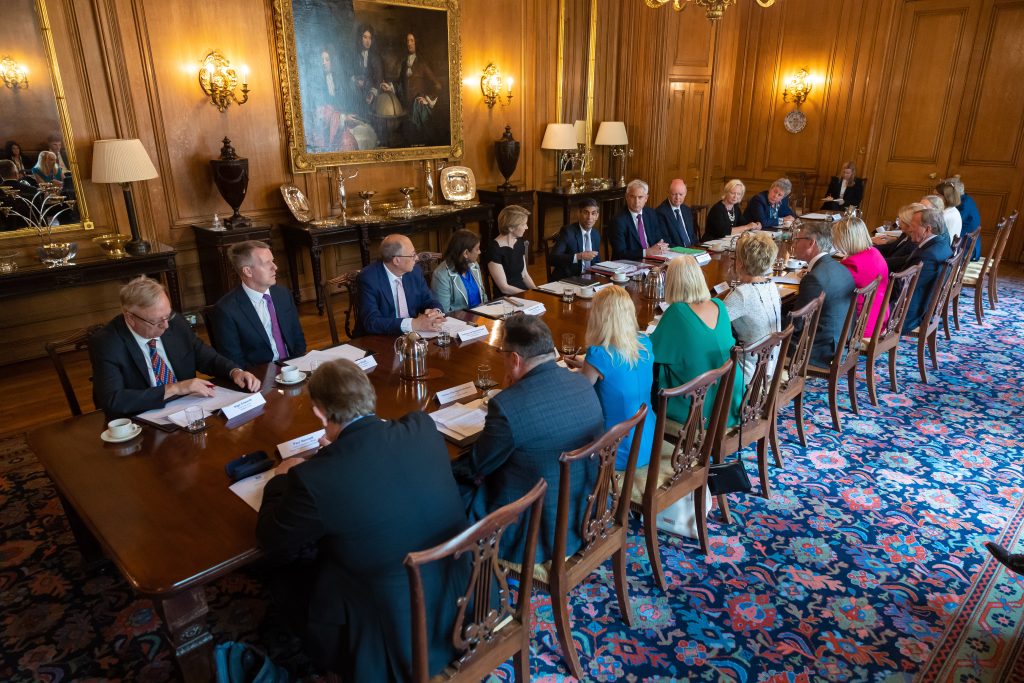
27/06/2023. London, United Kingdom. The Prime Minister Rishi Sunak hosts an NHS roundtable in 10 Downing Street with senior representatives connected to the NHS discussing the new NHS Workforce Plan. Picture by Simon Walker / No 10 Downing Street.
I think we have managed to change the narrative about crowding from ‘you’re just busy’, and I am pleased that 12 hour stays are now routinely measured from arrival in England. There is little serious disagreement about the mortality harms of long stays. To use a medical analogy, everyone agrees about the diagnosis, but I’m not sure that everyone agrees on the treatment plan. NHS England have got better about evaluating their initiatives, and I am sure that is because we have constantly bent their ears (and occasionally twisted their arms.)
A huge benefit of the role is meeting other college presidents and all sorts of interesting people in leadership positions. I’ve been surprised by how much health policy is influenced by personal relationships, networking is vital. I’m pleased that RCEM seems to be well respected externally. I think we punch above our weight in terms of influence, mainly because we have clear and unified policy priorities. A particular shout out should go to the leadership of the British Geriatrics Society, the Society of Acute Medicine, The Patient’s Association and the Association of Ambulance Chief Executives, who have amplified and supported our messaging.
I’ve also had bits of luck. I was travelling back from Cardiff by train when a pair of gentlemen sat opposite me. One started reading a copy of the New Statesman. Two weeks earlier, I had written an opinion article about emergency care problems and he was now reading the article. I took the opportunity to introduce myself (he checked that I was the same person as the photo.) The two men were members of the House of Lords, and by Reading I had persuaded them both to table a handful of parliamentary questions.
It hasn’t all been glamorous dinners, medals, beautiful buildings and robes. The travel has generally been enjoyable, though I have developed slightly sour views about many of our railway companies and my personal plea to improve UK productivity is to fix Wi-Fi on trains. The policy team have been a great support, but I must admit feeling very old when Tamara, a millennial, provided a devastating critique of my Spotify playlist while we were stranded waiting for a plane in Edinburgh. I’ve learnt to ignore the social media anons, trolls and headbangers, though it is fascinating when you find out who is behind an anonymous account. No one ever stays really anonymous on social media.
Much of the College’s time has been responding to external events and demands, but I’m pleased we managed to get the Guidelines for the Provision of Emergency Medicine Services (GPEMS) published. This is a first attempt to standardise our services, manage expectations and build good fences with our neighbours. It’s separate from the curriculum and the various training guides. I hope this eventually will support departmental accreditation.
It’s difficult to anticipate what my successor, Dr Ian ‘Higgi’ Higginson, is going to be confronted with, but crowding, an increasingly disaffected workforce and governmental apathy towards urgent and emergency care will be likely staples.
I have no doubt that the College is in safe hands with Higgi. He’s been by my side throughout my Presidency, as Vice President of RCEM, steadying the purple-sailed ship and took the helm when I was recovering from my biking accident. Higgi knows the ropes well and I look forward to seeing what he will achieve for you and the specialty during his tenure.
The President-Elect will be supported by our Vice Presidents, and I am delighted so many of our existing VPs are continuing their roles, providing excellent organisational memory, alongside some newbies.
I have had a lot of ‘what are you going to do next?’ questions. I am planning a break from any external activity until at least the new year. I may have some remedial work to tend to my annualised rota and I owe my Cambridge colleagues. I have always enjoyed the basic currency of our job; seeing patients and supervising residents and will just spend some time reconnecting with this.
Last but not least – it has been an absolute honour and privilege to lead the College and be a voice on your behalf – all 14,500 of you. I have thoroughly enjoyed meeting our members at numerous events and within EDs around the country, and beyond. RCEM connects people, allows you to share experiences in your EDs. We are an incredible bunch working in the best specialty (I might be a little biased...)
Keep looking after yourselves and those around you. Emergency Medicine is one hell of a ride.
For the final time, signing off as your President,
Over and out,
Adrian.
President’s Blog – August Newsletter 2025

Hello,
With everything going on within the healthcare landscape, it’s fair to say that it has been a rollercoaster of a month for everyone.
And yes, you are right when you think that I am alluding here to the recent industrial action in England.
When it comes to industrial action, RCEM respects everyone’s right to join a union and strike if they chose too. As with previous strikes, I was struck by how much efficiently our services ran. An increase in bed capacity and senior decision making really benefited our patients.
As a College, we don’t comment publicly about industrial action, but we all hope a resolution can be found soon and discussions keep happening around the table with all parties to achieve that shared aim.
Amidst the uncertainty, pressures and challenges we all continue to face, it was nice to take a moment, pause and celebrate the people within the specialty as a College at our diploma ceremony in Edinburgh.
It’s one of my favourite days on the calendar. We had 390 graduands crossing the stage across two ceremonies – FRCEM, MRCEM and ACP recipients - with more than1,500 attendees in total filling the room.
It was an honour to present the Alison Gourdie Medal, recognising clinical distinction, to Dr Madhumita Subramony who was the top performer in the 2022 MRCEM exam, along with awarding several College medals to Sally-Anne Wilson, Tess Sangers and Chris Moulton who also received the Dr Clifford Mann President’s Medal.
I, and everyone at the College, send our congratulations to everyone who has worked so hard to be there and celebrate with not only your family and friends, but your peers.
During the ceremony, as I stood on stage, looking out at the sea of talent wearing their regalia – caps, gowns and taking in that unmistakable electric energy that only comes with diploma day, it suddenly hit me: This is it. My final time celebrating graduates as President, donning the cape and medal before I hand over the responsibility to Dr Ian ‘Higgi’ Higginson in September (more on this towards the end of this blog).
There will be more of these final moments to come. And I am taking it all in, enjoying every opportunity before I sign off for the final time in the role.
As the graduate’s step into their next chapter, so too will hundreds of new trainees who we will all be welcoming to our departments this month. The College has some very useful induction e-learning modules for new doctors here.
Scrubs on, stethoscopes ready, nerves buzzing.
I remember walking into emergency medicine for the first time nearly 31 years ago (it honestly just feels like yesterday….) and oh how times have changed.
You enter Emergency Medicine during a time of transition as the government lays the foundation for the next decade.
Aptly titled the ‘Fit for the Future: 10 Year Health Plan for England’.
After months of comprehensive consultation, it was consolidated into a hefty 171-page PDF document.
And then consolidated down even further into a one hour press conference which also canvassed other political curveballs featuring Sir Kier Starmer, West Streeting and a special guest appearance from Chancellor Rachel Reeves after her weeping in the Commons incident.
Each taking to the mic for a ‘media moment’ in front of a room full of journalists at Sir Ludwig Guttmann Health Centre – the podium placed in front of a range of NHS staff.
“Reform or die” proved to be the quote of the day from the Prime Minister. Journalists taking that and using it for their headlines across different platforms.
Our Policy and Communications team tuned in, popcorn at the ready. Because we knew the plan would be bold, and would be broad. And indeed, it was.
A lot of grand ambitions to fulfil the government’s three aims: hospital to community, analogue to digital, and sickness to prevention.
It isn’t speciality specific and has no explicit mention of any diseases or professional groups. But we had been warned that it wouldn’t.
What it is is ambitious, wide ranging and most of it admirable in its aims.
What it lacks is more detail about delivery and we await more detail about this.
I have summarised what the plan means for us. It’s not that long, you probably wouldn’t even finish a cup of coffee by the time you’ve read it.
Just days after the plan was unveiled, the government also dropped the Leng Review – the independent review of PAs, who will now (again) be called Physician Assistants.
There is a lot of work going on in the background at the College about this review. Our Short Life Working Group is currently examining the recommendations before it is debated at our Council. We will provide further updates on this work in due course.
As I mentioned earlier, next month will be a time of change for the College as we welcome new and some more familiar faces to our leadership team.
Alongside Higgi, Maya Naravi, Salwa Mailk and Jason Long have all been appointed for second three year terms as Vice Presidents.
Meanwhile, two new VPs will also be joining them – Russel Duncan, currently the Chair of the Training Standards Committee, and Sally-Anne Wilson, the current Chair of the Yorkshire and Humber region, as well as the Chair of the Safer Care Committee.
Congratulations to all – the purple HMS RCEM ship is in incredibly safe hands with this leadership team and I can’t wait to see the incredible advocacy work the College continues to do.
I would also like to say a heartful goodbye to Russell McLaughlin, our Vice President in Northern Ireland, who is stepping down from this role.
He has been an amazing asset – fiercely advocating to improve UEC since he came into the position in 2023. Most recently, he was standing next to the Health Minister following a collaboration which will see the recruitment of up to 26 new consultants by the end of the year.
Thank you for everything you have done on behalf of not only members and colleagues Russell, but for the patients of Northern Ireland. I am sure you will all join me in wishing him well on his new endeavours.
And I congratulate Michael Perry as he takes over the reins. A call for nominations for a new Vice Chair for the Northern Ireland Board will be made shortly so keep an eye on your inbox for that.
As we now enter August, I hope you have had the time to get out of the department and enjoy the sun – whether it’s been around the UK or abroad.
It’s important to take time out and breath the fresh air, especially as the pressure remains and wait times balloon.
No matter what is happening in EM, and across the health care system, we are all in this together. Look out for one another.
Adrian.
President's Blog - July 2025
Hello,
This Friday will mark one whole year since the Labour Party was elected into power and Sir Kier Starmer put his feet under the Prime Ministerial desk. The following day, Wes Streeting was handed the bulging ‘NHS’ briefcase aka a political hot potato.
The first 365 days could be considered a honeymoon phase. Loaded with political ambition, fresh energy, dreams and aspirations.
Also, numerous political catchphrases that have been used time and time again.
The NHS “may be broken, but it’s not beaten”, anyone?
Twelve months in and so far we’ve had words, reviews, and plans.
It’s almost like Oprah walked into 10 Downing Street and said, “you get a plan, you get a plan, everyone gets a plan!”
And among those PDF plans, was the recently released Urgent and Emergency Care Plan.
There was no flashy press conference. Wes Streeting didn’t walk up to a podium with a motivational speech. Quite the opposite.
Just unceremoniously landing in our emails.
That being said, as I opened it and started to dissect the plan, one thing was clear.
The government is under no illusion about how big the mountain is they have to climb to get Urgent and Emergency Care back on track to being a system that functions how it should.
Under the title ‘the imperative for change’… was the following:
The current state of “UEC services does not meet the standards our patients need or out frontline staff want to deliver” – correct.
“The pubic continue to feel the impact of poor UEC delivery” – correct. Just look at the British Social Attitudes Survey.
“We’ve normalised asking our staff to deliver sub-optimal care, and our patients have all but given up hope of expecting a reliable service in urgent care” – and sadly, correct.
Also, at point nine, mentioning the “burnout our frontline staff feel” – correct again.
Aside from the grand sweeping statements, that were on par with the Darzi review, there was something we were pleased about.
There has been a commitment to publish site-specific data.
We have actively campaigned for this to become a reality, positioning it as one of our key policy priorities in our Roadmap to Recovery.
The current process of bundling together Type 1 departments with minor injury units, eye units and UTCs make the figures look good…
This will greatly improve transparency, enable comparisons of local health systems, and help to ensure that previous resources are distributed in the most efficient way.
As you know, NHSE already has this data at their fingertips. It was just a matter of hitting the big green ‘transparency’ button.
If you want to read more about the good, the bad and the ugly contained in the plan, I’ve put together a ‘one stop shop’ analysis of it here.
But in essence…
Will this plan improve the experience of an 82 year old grandmother on a trolley in a corridor who has been in our department for over 12 hours?
I fear not.
Mainly because there was an acceptance that 10 percent of patients who attend A&E will wait more than 12 hours.
Using last year’s data for England, that would have been almost 1.7 million people.
No one should.
And from what I’ve been told about the 10 Year Plan… I fear that won’t help an 82 year old grandmother in our corridors either.
So much so I raised these concerns with Laura Donnelly at The Telegraph.
I now wait with bated breath to see if politicians hit the Ctrl+Alt+Delete button on aspects of the plan and start again…. Only time will tell.
But one thing that has been a common occurrence across the UK, has been various government’s laser focus on the progress on reducing the wait times for electives.
A classic example of ‘look here, don’t look here’.
While directing huge wads of cash towards greater improvements.
In Scotland – Health Secretary Neil Gray announced more than £106 million to tackle elective lists (all the while they’ve just announced they had a record number of delayed discharges last year).
Meanwhile in Wales – Health Secretary Jeremy Miles MS revealed a new Planned Care Recovery Plan to reduce waiting lists by 200,000. Pumping in £120million to do so.
While obviously cutting waiting lists is a good thing, Dr Rob Perry, our Vice President of Wales, appeared on BBC’s Sunday programme, Politics Wales, to reiterate our point – you can’t fix one without fixing the other. They go hand in hand. In case you missed his interview, alongside the Royal College of Surgeons, you can watch it here.
But behind closed doors, our advocacy and policy work is continuing as always. Like a well-oiled machine. Holding the government to account, ensuring they understand exactly what you, your colleagues, and our patients are experiencing every single day.
I recently met with Karin Smyth, Minister of State for Health (Secondary Care). We provided a briefing note beforehand and had a good conversation. She was interested and engaged.
From one part of the government, to another – the Home Office has recognised the extremely important role that ED staff can play in sharing information about violent incidents in our communities.
As I’ve mentioned in previous Blogs, they approached us and we worked with them to establish a new Standard Operating Procedure in a project called Information Sharing to Tackle Violence (ISTV).
We know that around three-quarters of violent incidents are not reported to the police.
While we can all play a part in making our communities safer, you can go one step further and become an ISTV Ambassador in the College’s mission to establish the programme in every ED.
You can learn more about it here – along with a podcast that delves into the scale of the problem.
While improving safety, you can also improve the care of our patients by getting involved with our Quality Improvement Programme competition.
It’s that time again to submit your idea in our competition for the 2028-2033 cycle, with the winning concept developed into a fully realised national QIP.
You have until 11:59pm on 25 July to submit your idea.
While it permanently feels winter in our departments, with corridor care and lengthy waiting times, it’s apparently that time of year again when temperatures are rising.
I’m sure in recent days you’ve already dealt with vulnerable patients experiencing heat stroke or heat exhaustion. And it’s not even peak summer.
It’s a timely reminder to re-read our module on both conditions as we are surely in for more heat alerts (as I am typing this, I just got a breaking news alert to say the UKSHA has just released another amber warning for parts of England).
NHS England’s own website saw a surge by nearly 200% in people visiting its heat exhaustion advice page.
A symptom of the climate crisis, one the College takes very seriously and is why the GreenED programme has taken off across the UK and now, in other parts of the world, to ensure we play our part in tackling the ever-growing threat.
A massive congratulations to the 10 Emergency Departments in England and Wales who have been accredited under the programme last week.
Among the incredible achievements, Northumbria Specialist Emergency Care Hospital was awarded Gold – a GreenED first.
It’s been fantastic to see the range of actions implemented, from reusable PPE and suture kits, to reducing nitrous oxide use.
The next 12-month cycle starts in September and registration is already open for your department to express their interest in taking part.
Compared to the start of this blog, it’s nice to be able to finish on a more positive note.
Time and time again, I get to see and read about the incredible difference we are making for our patients – not only their care in our departments, but improving their overall health by improving the health of our planet.
Adrian
President’s Blog – May Newsletter 2025
Hello,
At the time of putting pen to paper (these days, hands to the keyboard) I fully intended to give you an analysis of the UEC reform plan.
However, it hasn’t landed on our doorstep, aka emails, as yet. Talk about more suspense…
But what did land in our emails, and in the media last week was a compelling report by The Health Foundation, revealing the pressures the speciality faced this past winter in England.
Calling the system “in distress” their report backs up what we have been voicing through the winter megaphone: the number of 12 hour waits before admission reached a new record high and diverts and ambulance handover delays were worse than over previous winters.
And it highlighted how it’s not about increased attendances, it’s about flow. The report spelled out clearly that slightly fewer patients attended over winter compared to 2023/24 but the NHS struggled to cope with patients who needed to be admitted.
It can all be summarised by a term I have used time and time again over the past few months – winter illnesses have been the straw that broke the camel’s back.
I should make a compilation video of the times I’ve said this in the media over winter…
But it’s one I will continue to repeat and one I will most likely reiterate in my speech at our upcoming launch event of our newly formed All Party Parliamentary Group (APPG) on Emergency Care next week.
We have cast the fishing net wide to invite politicians and other health organisations to be under one roof because when it comes to advocating for UEC improvements, we want them in the room, ears open, and ready to listen, and what they will hear, will be hard to ignore. Keep an eye out on our socials to see what I announce at the event. One clue… it involves compelling data.
And speaking of data, our recently published Quality Improvement Programme reports are full to the brim with statistics on the level of care certain patient groups are receiving in A&E in the backdrop of challenging conditions.
Our Time Critical Medications QIP was covered widely in the media – which concluded many patients who rely on time critical medications for Diabetes and Parkinson’s aren’t always getting their drugs while in ED.
Our Mental Health QIP found patients who are suicidal or have self-harmed spent nearly 11 hours, on average, in ED last year.
While our Care of Older People QIP found not every patient over the age of 75 underwent screening for delirium, frailty and had a falls risk completed. With this release, we also revealed new analysis on the number of older people who endured a 12 hour wait last year. I got the call up from BBC’s Today Programme about our report and advocated for the focus to be on these long waits, instead of the four-hour standard.
Meanwhile, Wes was responding to our figures in multiple media interviews – calling long waits for people “who’ve paid into the NHS all their lives… appalling” but said the “scale of the challenge is one that can’t be fixed overnight or even within a year.”
Our QIPS are vital to show insights into the level of care these vulnerable groups are receiving, to further advocate on behalf not only them, but you, for change.
Thank you to all the EDs that have taken part in these QIPs and to those who have signed up to take part and submit data this year. If you don’t know if your department is involved, or if you’d like to find out more about participating, email our team at RCEMQIP@rcem.ac.uk
Each report also provides valuable recommendations to implement in your departments. I suggest some light evening reading (when you have the rare luxury of some down time).
They are a good example of the diverse work the College does and our commitment to the specialty extends far beyond the boards of the UK.
Since my last update, we have signed a partnership agreement with the Ethiopian Society of Emergency and Critical Care Professionals (ESEP) to improve EM practice and training. It’s backed by a £200,000 grant that was secured through the Global Health Workforce Programme and will focus on four core areas, including the expansion of the Basic Emergency Care training programme. At its core, it’s all about shared learning.
And that’s exactly the ethos behind our new Flagship Conference that will take place next year.
We have merged both our Spring CPD Conference and Annual Scientific Conference to become, essentially, one big mega conference. Get your diaries out now and schedule it in – 28-30 April. The ICC in Birmingham will host the event and you can already register your interest to attend here.
I must also plug that applications are open to join our College Council and Executive Team as Vice President, as well as Vice President Membership.
We have three Vice President roles open, and all the details about how to apply are here – https://rcem.ac.uk/volunteering-opportunities/ – deadline 12 May 2025, to take up position in September, when I also hand over the Presidential reigns. I can honestly say the roles are incredibly rewarding and I would encourage you to put yourselves forward.
With so much change on the horizon for our specialty and the wider healthcare system, it’s more important than ever to fight for our colleagues, and our patients.
Adrian.
President’s Blog – April Newsletter 2025
Hello,
And goodbye to NHSE.
Wasn’t that a mic-drop moment from the Prime Minister last month as he just unceremoniously threw the ‘world’s biggest quango’ onto the political bonfire!?
An announcement that was made casually during a speech that started with how he just saw the first bottle of Dettol to ever be produced, in the setting of a company behind health and hygiene consumer brands.
I didn’t pick this to be the backdrop of delivering a huge policy plan that will significantly change and alter the course of healthcare in England and the careers of many thousands of people. My thoughts are with everyone affected– change is never easy and swingeing cuts even less so.
Once the guardian of public health, it feels like we are now preparing for NHSE’s inevitable passing, requiring delicate palliation.
It has two years left to draft its will and tie up loose ends to get all its affairs in order.
It’s left me, and I’m sure you, with a lot of questions.
The main one being what happens now for the nation’s healthcare system and the people who rely on it?
Since the announcement, it has been radio silence from the government about how this complex task will be achieved.
And like someone waiting 12 hours in one of our departments, we are patiently waiting, watching and listening for more information.
The delivery of the Spring Statement didn’t provide any insight either.
Rachel Reeves iconic red ‘looks important and impressive’ ring binder failed to hold any documents or money relating to Urgent and Emergency Care.
Just pages filled with economic jargon and a few mentions of cutting elective waiting lists.
Yes, cutting elective waiting lists are important… but it can’t be done in isolation. You can’t focus on one, without focusing on the other – long waits such as in EDs.
It was disappointing to say the least but slightly expected.
And the public have voiced its opinion on this too.
Respondents to the latest British Social Attitudes survey put tackling ED waiting times as their second highest priority – behind access to GPs and AHEAD of waits for elective care.
Published this week by the Kings Fund and the Nuffield Trust – and was conducted between September and October last year across England, Wales and Scotland.
The results also showed more than half (52%) were dissatisfied with NHS A&E services – the highest on record, up 15% from the previous year.
No surprise really given the current state of EDs. Maybe it’s time for politicians to listen to their constituents?
Meanwhile, we are still waiting for Wes Streeting’s ‘Urgent and Emergency Care Improvement Plan’.
On 7 January, the Health Secretary said it was coming “shortly”.
His definition of ‘shortly’ must mean, ‘we’ll get to it when we get to it’.
But how do you deliver a plan when you’ve got rid of the delivery arm?
Same goes for all the other plans that are waiting in the wings – the 10-Year Health Plan, the Long-Term Workforce Plan.
But as we await the words in these plans, our policy and advocating work continues.
Last week, we revealed every ED in Wales is caring for people in corridors – again, no surprise to me and you, but it’s yet more evidence that the government can’t ignore.
This came from a ‘snapshot’ survey which was conducted on three different dates and times in January and February with all 12 Emergency Departments in Wales submitting results.
The results revealed that:
- 12 out of 12 Welsh EDs had patients being treated in corridors
- Of the average total of 619 patients present in EDs at the time, 13.5% were being treated on trolleys in corridors and other inappropriate spaces.
- A further 10.7% of patients in waiting areas were deemed as needing a clinical space.
- 9% (272) of all patients were waiting for an inpatient bed.
- Every ED’s cubicles were full, with the average cubicle occupancy being 176%. The highest being 278% in one department where there were 75 patients and just 27 cubicles.
These statistics caught the eyes of the media and both the name and face of our Vice President in Wales, Dr Rob Perry, appeared in online articles and mentioned on radio and TV as we called corridor care an ‘endemic’.
As our concerns bubbled away in the media, I did a presentation on the same topic (Crowding) at the Spring CPD Conference in Birmingham last week.
Last year, I was on two crutches, hobbling about after my incident, and fast forward this year, I only required one. Significant improvement.
The programme was full of educational and informative sessions, and I hope those of you who joined in person and online learnt something new to apply in practice.
As ever, thank you to our Events team for putting it altogether and bringing it to life. Attending our conferences and meeting so many of you really is the favourite part of my job as President.
It was great to see so many of you in person and share our knowledge, experiences and best practice to advance the speciality and ultimately, patient safety.
A theme that our Patron, Her Royal Highness The Princess Royal, emphasised in her keynote address after meeting delegates and speakers.
She also met with representatives of our GreenED team, to provide an update on the programme and how it’s driving environmentally sustainable practices in EDs.
It was an honour to have Her Royal Highness at the event, as we also marked 10 years since the College was granted its ‘Royal’ title.
As the final session of the conference came to an end and the metaphoric curtain gently fell, we found ourselves marking yet another goodbye — this time, to the Spring CPD Conference itself.
Stay tuned for more updates about what we have install for you and your colleagues next year.
The final winter ‘situation report’ from NHSE might be coming out tomorrow, but I fear we are not quite out of the winter woods just yet.
But until we are, I hope you can enjoy the sunshine, and keep looking after each other.
Adrian
President’s Blog – March Newsletter 2025
Hello,
It feels like spring has well and truly sprung.
Bluebird days (there’s been more than one in a row, not that I’m counting…), frosty mornings and the very welcome sight of the sun setting after 5pm.
But let’s be real, the feeling of spring hasn’t reached our EDs.
In fact, it’s nowhere to be seen. It’s ‘winter’ business as usual.
Cases of norovirus remain staggeringly high, along with bed occupancy.
And we know what this means… high occupancy = high infections.
A vicious, and very unpleasant cycle.
The constant game of ‘is a bed free yet’ is one that has no end in sight.
Like a long-winded game of Monopoly, with a single player having the majority share of houses.
But it’s our patients who aren’t passing ‘go’, stuck and stranded in our EDs.
In January, England reached a new record of trolley waits – 61,529 people waited 12 hours or more after the decision to admit.
Meanwhile, Northern Ireland experienced its worst year, quarter and month of December ever recorded.
We have been clear to all our governments – we can’t experience another winter like this again.
It’s simply not sustainable for staff, and it is a risk to patient safety.
And rest assured, we are at the table, in various rooms, virtually too, advocating on your behalf at every opportunity to influence the government’s various plans.
Plans, upon plans, upon plans.
The upcoming Urgent and Emergency Care Reform plan, the 10-Year Health Plan, the Long-Term Workforce Plan.
All of which can’t come soon enough…
It’s all well and good having a ‘plan’ but it must be tangible and effective.
I am waiting with bated breath, but I’m certainly not holding it. I am sure many of you are the same.
As part of our work to have the call end corridor care heard in the corridors of power – we have accepted the invitation to manage the newly formed All Party Parliamentary Group (APPG) on Emergency Care.
The purpose of the cross-party group is to advocate for improvements in UEC.
It’s brought together some high-profile names, including Labour MP Dr Rosena Allin-Khan, an EM Doctor, who has been elected as the group’s Chair, vice chair is former Health Secretary and Conservative MP Jeremy Hunt.
Other members include Labour MP Dr Beccy Cooper, a public health doctor, and Labour MP Paulette Hamilton, a former nurse – both of whom sit on the Health and Social Care Committee.
It’s an exciting development that has taken place in the last month, and you can read more about it here.
Someone who will now not be giving evidence to the APPG is Amanda Pritchard – the now former CEO of NHSE.
It’s certainly been a challenging couple of years to be at the helm of ship ‘NHSE’ – the covid pandemic proving to be the storm of all storms out at sea.
Her departure heralds a new chapter for NHSE and Sir Jim Mackey has his work cut out for him as he takes the ship’s wheel for the interim.
On the topic of departures, I would sincerely like to thank Dr John-Paul Loughrey, for being such a formidable advocate for safe, high quality Emergency Care during his tenure as Vice President Scotland.
It was fitting that his final comment in the media was shot across the bow at the Scottish government about the scale of 12 hour waits which are 99 times higher than they were 14 years ago.
I am sure you all join me in wishing JP all the best, as we welcome Dr Fiona Hunter into the role, alongside Dr Jayne McLaren who has been elected as Vice Chair Scotland.
Despite the ongoing challenges we face, I can’t help but feel a sense of optimism after attending the EMTA conference in Bristol and Faculty days in Cardiff and York.
It was a great opportunity to meet delegates during the engaging programme and I have no doubt the future of the specialty is in good hands.
To all EMTA members – keep an eye on your emails in the coming days as you will be receiving the EMTA survey which will help us to better support you.
Thank you to EMTA, the EMTA Committee, and the College Events team in making the two-day conference such a success.
And a special shoutout to EMTA’s Conference Lead, Dr Joesphine Darke-Mo who organised the event along with her 12-week-old baby girl, Lottie! It really is never too young to nail your colours to the EM mast!
The next major event that should be in your calendar is the Spring CPD conference, at the end of the month in Birmingham (25-27 March 2025). I hope to see you there in person, but if you can’t attend, there is always the option to join us virtually.
By then, I know we all hope to start seeing the effects of Spring and the ray of hope that cases of norovirus subsiding will bring.
Let’s hope it lives up to being known as “the season of hope” for EM.
Adrian.
President’s Blog – February Newsletter 2025
Hello,
Well January has come and gone… and let’s just say, it has been a month.
In my last update, I said flu had hit and hit hard. Fast forward 31 days and boy, did it ever… along with the other classic viruses attached to winter.
The ‘quad-demic’ definitely turned out to be the perfect toxic cocktail that spilled chaos into every corner of our EDs.
It spilled into the media too – a flurry of headlines about critical incidents, corridor care, ambulance delays, standards of care. The lot.
And with that, journalists came running to us for interviews and statements. We made sure to make the most of the media spotlight on our speciality to advocate for change.
While it often feels like we are the Royal College equivalent of a yappy terrier in a purple jumper, over recent weeks we have seen the rest of the pack amplify our key asks of the powers that be. And the more dogs in the fight, the harder they are to ignore.
RCEM co-signed a letter written by the RCN to the Health Secretary calling for an end to ‘Corridor Care’ before they released thousands of testimonies from nurses across the UK, detailing their experiences treating patients in storerooms, carparks, offices and even toilets.
While it made for sobering reading, I’m sure many of you could sadly relate.
Meanwhile, new research out by the ONS also reinforced what we know – long waits are a threat to patient safety. The defining study found that patients who wait in ED for more than two hours are exposed to an increasing risk of death. And by the time a patient reaches a stay of more than 12 hours in an Emergency Department, they are twice as likely to die within 30 days as those treated, admitted or discharged within two hours.
Data too compelling to ignore.
The RCP also wrote a position statement calling for a ‘zero tolerance’ approach to corridor care, while we also co-signed a joint statement with ACCE, RCGP and other organisations that listed UEC improvement proposals. It also clearly stated the NHS ‘got the winter it prepared for’.
I cannot tell you how much I enjoy seeing our fellow Royal Colleges and other influential organisations amplifying our messages and vocalising the need for change.
But it looks like we will continue to be pummelled by the system for some time yet, especially after the release of NHSE’s planning guidance last week.
An ironic title when the 19-page document, failed to provide much ‘guidance’ at all on how the government will tackle corridor care and waits.
While it did acknowledge the fact that the number of people waiting 12-hours or more continues to rise, they only set the unambitious four hour target of 78%.
Still focusing on the wrong standard – and not where the real risk lies. A case of ‘Look here. Don’t look over there!”
On the same day the DHSC published its ‘mandate for the NHS’.
It had a foreword from the Health Secretary and the message was clear.
Work harder and faster while getting “back to basics”.
I’m getting that déjà vu feeling again…. John Major in 1993?
I am sure we would all love to ‘get back to basics’ like treating patients in appropriate clinical settings, being able to secure those who need it an in-patient bed, or even just maintaining patient safety.
But at the moment it feels like having five minutes to grab a cuppa or even sometimes finding the time to go the loo is a luxury we can ill afford when we are working in departments that are so full – every inch and every second is used.
However, enough of the shroud waving. I was reminded this month as to why we do this – seeing the dedication and passion for EM at our recent winter diploma ceremony.
It’s one of my favourite events of the year for this reason. It was a privilege to see the future of the specialty crossing the stage, where our VPs and directors celebrated their successes while their loved ones looked on sharing the moment which has taken so much hard work and dedication to achieve.
It was one of the last times I will wear the President’s regalia before I hand over the title, ‘cloak’ and chains to our new President Elect Dr Ian ‘Higgi’ Higginson.
He was confirmed as the College’s next president at our Council meeting a few weeks ago. I am sure everyone here at RCEM will join me in saying congratulations to him on his new role.
I have no doubt that the College will be in safe hands, as he knows the ropes well through his experience and time as Vice-President and I look forward to seeing what he will achieve during his tenure.
The official handover will take place at the College’s AGM later this year. But for now, we have double the fire power, at the helm to help steer the EM ship away from the iceberg.
We have some exciting new developments that will be taking place inside the walls power in the coming months – make sure you look out on our socials for this.
While we have seen some of the worst cards dealt to EM with this winter, I have also seen some of the best in our workforce.
Even more so when I returned slowly to the shop floor in the past couple of weeks, after a successful hip operation got me back on my feet after my cycling accident just over a year ago (no, I did not celebrate a hipiversary!)
Stepping back in (albeit sometimes a bit wobbly) I felt like a fish in water – back on the shopfloor, doing what I love.
As ever, we will keep advocating for you and your colleagues. Our profession got through the toughest months of winter, as we knew we would, albeit a bit battered and bruised.
Just like how hard flu hit, we will make sure our campaigns hit the government hard in our efforts to try to make are this winter is never repeated.
Now as I regain the ability to walk without any assistance, I am starting to itch to up my level of physical activity.
And I was both motivated and left with a real sense of inadequacy when I watched amazing RCEM Fellow Dr Scott Castel on Gladiators a couple of weeks ago.
Not only did he look great in his Lycra outfit, and perform really well, he also causally popped his own dislocated finger back in – not just once but twice – right there on primetime TV!
Just proving to the world EM clinicians are made of tough stuff.
But of course, we all knew that already!
Adrian.
President’s Blog – Newsletter January 2025
Hello,
Happy New Year if it is not too late to wish you that. I do hope that you managed to get some downtime over the festive period.
While many people get to enjoy some rest at this time of year, for us and our colleagues, December and January are usually our busiest time. And hasn’t that born out this year?!
Flu hit early this winter. It hit hard. And it is still pummelling the crap out of us now.
Winter is also the time you can almost guarantee the media will start to show a significant interest in the pressures facing the UEC system. As seasonal as the Coca-cola lorry and the John Lewis advert.
‘North Face’-bedecked reporters standing next to hospital signs in the snow/rain/wind counting the number of ambulances parked outside the ED, or listing the number of hospitals currently in a situation deemed a ‘critical incident’.
Journalists love a nifty, shorthand way to refer to things (think Brexit, Wagatha Christie etc).
Well, when it comes to the multiple whammy of infectious diseases we are currently dealing with, the moniker of choice has become ‘Quademic’ – flu, RSV, Covid and Norovirus. I was toying with Flu-nami but that image is a little too much for even me!
And while the public focus on the pressures on our specialty is welcome, I know it will provide little comfort to you walking on to the shop floor to see an intricate version of trolley Tetris laid out before you.
I have been determinedly engaging with as many media outlets as I can. In the nicest (and not creepy) way possible, I want the Health Secretary to be dreaming about the Emergency Care crisis, which will hopefully galvanise him and the Government into meaningful action.
I can tell them now – blaming the Tories for another winter crisis is not going to cut it. Currently the Government has ‘elected’ to focus elsewhere.
The big announcement this week was ‘community diagnostic hubs’ in its drive to reduce waiting lists for elective care. A lovely aim – reducing elective care waits are important. But – at risk of sounding like a broken record and in the certainty that I am preaching to the choir – you cannot just fix one bit!
And that applies to social care too – which has now been kicked down the parliamentary road with the announcement of a review by Baroness Casey which is not due to report fully until 2028.
I am getting a funny feeling of déjà vu – Dilnot Commission anyone?
During a parliamentary debate on NHS backlogs this week the Health Secretary said the Government is already planning for next winter. Excellent news.
May I suggest a comprehensive, independent review (no marking your own homework here) to establish what has made a positive impact (and do more of it) and what hasn’t (and bin those).
You can have the best laid plans in the world – but if you fail to assess, evaluate and learn from them, then it’s pretty much sticking your finger in the wind.
During the same session Helen Morgan MP, Lib Dems’ Health Spokesperson, urged the SoS to set up an urgent and emergency care taskforce. In response Mr Streeting said “Let me reassure her that the Minister of State for Health the Member for Bristol South (Health Minister with responsibility for UEC Karin Smyth MP) and I have every week—and often more frequently—convened health and care leaders virtually and in the Department to keep a grip on what is going on, to provide as much central support as possible, and to respond to crises as they emerge.”
I must have missed that invite – I’ll drop him a DM.
In other news, I want to congratulate Dr Jayne McLaren who has been elected as RCEM’s Scotland Vice Chair, and my thanks to Dr Krishna Murthy who also stood.
Jayne will take over from Dr Fiona Hunter, who becomes RCEM VP Scotland when Dr JP Loughrey’s term ends later this year. My continuing gratitude to all the team for their hard work.
Read more about Jayne here – https://rcem.ac.uk/news/dr-jayne-mclaren-elected-as-vice-chair-scotland/
And if you fancy getting more involved in the work of the College yourself then check out our latest vacancies – https://rcem.ac.uk/volunteering-opportunities/
It is also not too late to submit a nomination to succeed me as RCEM President. All the details about how to do so are here – https://secure.cesvotes.com/V3-3-0/rcempresident/en/home?bbp=90423&x=-1
The deadline for submission is 12pm on Monday 13 January 2025.
It is the best job working on behalf of the best speciality so please do consider it.
Adrian