Using education to connect with the global emergency medicine community – my experience in Libya and a limited prehospital environment

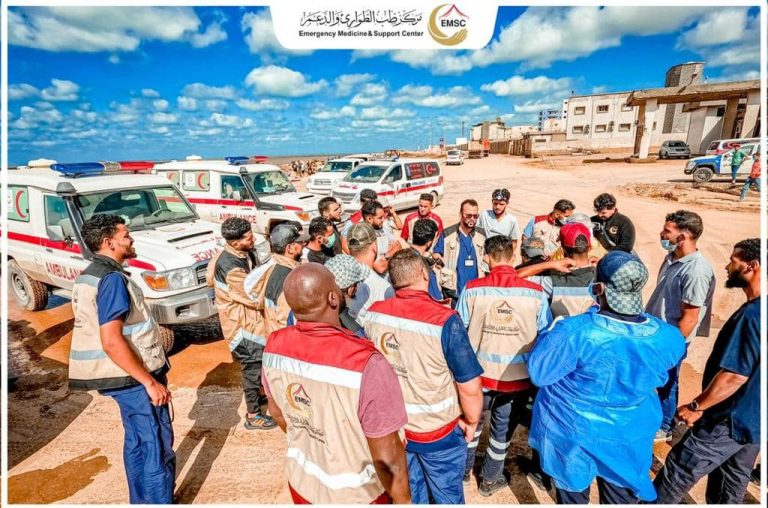
a group of several medical professionals in Libya huddling around ambulances
Emergency Medicine Support Center staff gathering outside a hospital in Libya

26.05.2026

By Dr Hamdan Hilan, Emergency Medicine Physician, Libya.

I want this to inspire greater awareness of how global learning communities can support diversity, professional development, and system-level improvements across varied clinical environments.

To be an Emergency Medicine (EM) physician working in a Libya’s resource-limited environment presents additional challenges because of how unestablished our speciality is in the region. Formal systems of shared knowledge and structured training are scarce.

Across Libya, the Emergency Medicine and Support Center (EMSC) is the official national body responsible for emergency medical response, ambulance services, and disaster preparedness and response. The Center leads frontline emergency operations, coordinates disaster response activities, and delivers structured training and capacity-building programs for medical and prehospital staff nationwide.
Despite the limitations in this environment, my passion for improving emergency care in my community has driven me to work persistently on strengthening emergency and disaster response systems.

Without the benefit of many local role models or abundant educational resources, I have had to be self-motivated, adaptive, and innovative. I started by conducting needs assessments, drafting standard operating procedures (SOPs), and training responders across different regions. All grounded in the mission to build structured prehospital care where none existed before.

One of the single most transformative resources that has supported my development is RCEM Learning, the Royal College of Emergency Medicine’s e-learning platform.

This platform has been a cornerstone for expanding my clinical knowledge, developing critical emergency-focused skills, and tracking my professional growth through structured modules. RCEM Learning has enabled me to access high-quality, curriculum-aligned educational material that I otherwise would not have had in my local setting.
It has provided me with a sense of connectedness to the global EM community and strengthened my clinical practice despite my physical and systemic isolation. Access to structured international educational tools such as RCEM Learning has not only helped me improve individual practice but has also informed the strategic direction of broader emergency systems development, from training packages to national guidelines.

These modules and topics have been particularly valuable in my Emergency Medicine practice and professional development. I have especially benefited from content related to:

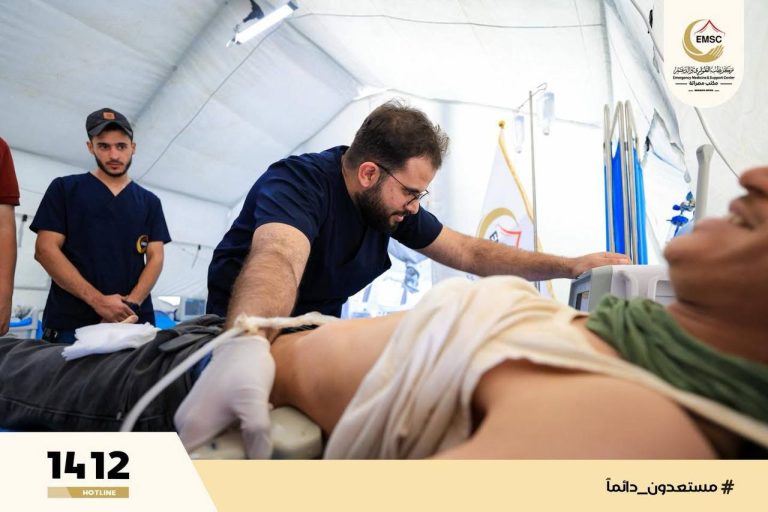
A staff member from the Emergency Medicine Support Center practicing an ultrasound on a student

One area that I initially found particularly challenging, yet extremely valuable, was content related to Pre-hospital Emergency Care, Retrieval Medicine, and Helicopter Emergency Medical Services (HEMS).

In Libya, we currently face significant limitations in prehospital infrastructure, including the absence of a fully developed retrieval system or operational helicopter emergency response framework. Many of the concepts presented in RCEMLearning, particularly those relating to HEMS operations, prehospital critical care, and retrieval medicine, were initially difficult to contextualise within my local clinical environment.

However, studying these modules proved to be highly inspiring and educational. They provided insight into advanced emergency care models, system design principles, and operational structures that are not yet widely implemented in my setting. This knowledge has helped shape my perspective on system development, disaster response planning, and the long-term vision for improving emergency and prehospital care services.

This experience has underscored the value of inclusive, accessible, and resource-aware learning platforms for clinicians around the world. Sharing this story, I hope to highlight the importance of equitable access to quality emergency medicine education and the transformative impact it can have on physicians practicing in under-resourced environments. I also want it to inspire greater awareness of how global learning communities can support diversity, professional development, and system-level improvements across varied clinical environments.

About the author

Dr Hamdan Hilan is an Emergency Medicine physician from Libya and EMT-LY focal point working on developing emergency care, prehospital medicine, and field emergency medicine systems in Libya through education, training, and adoption of international standards including WHO EMT initiatives.
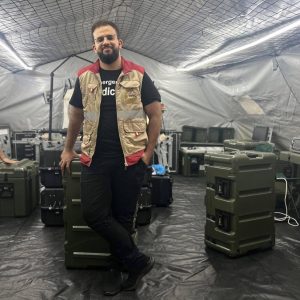
Dr Hilan standing in a emergency medicine centre with several pieces of equipment around him.

Share Your Story

This blog is part of RCEM’s Share Your Story campaign, an initiative that invites the EM community to share their written or video experiences to help build inclusion, understanding, and equality across our specialty. We welcome contributions for medical awareness and diversity days throughout the year, chosen in collaboration with our EDI Committee and NHS Employers.