
RCEM Quality Improvement Programme 2026 – Registration Now Open
Registration is now open for the Royal College of Emergency Medicine’s (RCEM) 2026 Quality Improvement Programmes (QIPs).
The QIPs support Emergency Departments in delivering safe, effective, and high-quality patient care through structured, data-driven improvement work. Participating sites will have access to the RCEM Quality Improvement Portal, ongoing guidance, and tailored resources to support progress throughout the year.
2026 QIP topics:
- Care of Older People in the ED
- Adolescent Mental Health
- Time Critical Medications
Emergency Departments can now register to take part in the 2026 cycle:
Key Dates
- Inclusion Period: 1 January 2026 – 31 December 2026
(All eligible patients attending a participating ED during this period may be included.)
- Data Entry Period: 31 January 2026 – 31 January 2027
(All data must be submitted by 31 January 2027.)
For any queries, please contact the QIP team at rcemqips@rcem.ac.uk.
We have a number of committees and working groups which look after quality in Emergency Departments, with the aim of improving standards and patient care.
A key part of this work is our Quality Improvement Programme (QIPs), which you can read more about below, along with resources and guidance.
Please read RCEMs Quality Improvement Plan below for details on our programmes annual focus and objectives.
You can also see more about our clinical guidance in our Clinical Guidance section.
Need help? We are happy to assist. Please check our support section for more details.
Quality Improvement Programmes
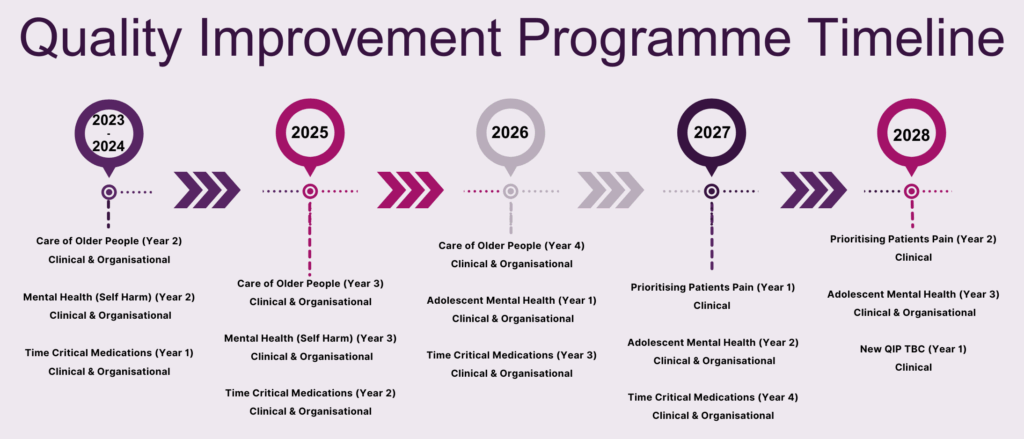
Our 2025 QIPs are listed below and can be found in the HQIP directory.
The 2025 inclusion period is 1 January 2025 – 31 December 2025: Any patients that meet our QIPs inclusion criteria and have attended a participating ED within the inclusion period are eligible for this cycle.
The 2025 data entry period is 31 January 2025 – 31 January 2026: All data for the 2025 cycle must be submitted within this period.
There will be no RCEM QIPs running between October – December 2024. If you participated in the 2023-24 QIP cycle and are continuing your participation in 2025, you have no obligation to record any data for patients attending between October – December 2024.
Please note, the National Data Opt Out Policy began on 31 March 2022 and as data inputted into QIPs is anonymous, it does not apply to RCEM – you can however read our statement on it here National Data Opt Out Policy statement.
QIP Portal Login Troubleshooting

QIPs Running in 2025
Mental Health (Self-Harm) (Year 3)
Data entry (Year 3: Jan 2025 – Dec 2025)
Mental Health Self-Harm QIP Information Pack (Year 3)
Care of Older People (Year 3)
Data entry (Year 3: Jan 2025 – Dec 2025)
Care of Older People in the ED QIP Information Pack (Year 3)
Time Critical Medications (Year 2)
Data entry (Year 2: Jan 2025 – Dec 2025)
QIP Webinars On-Demand
QIP Webinars On-Demand


Frequently asked questions:
What are QIPs and why should we sign up?
RCEMs QIPs are designed to help hospitals enhance the quality of care in emergency settings through a quality improvement framework. These projects provide a structured approach to identifying areas for improvement and implementing changes that can lead to better patient outcomes. We have three QIP topics running every year.
Who can take part in RCEM’s QIPs?
Our QIPs are open to all Type 1 UK Emergency Departments. Each Emergency Department needs to complete its own registration form and indicate the QIPs it will be participating in.
How do I register for the QIPs?
You can complete the registration form by visiting https://rcem.ac.uk/quality-improvement.
Can I sign up for more than one QIP?
Yes, and it is also more cost effective to sign up to more than one QIP at a time.
What is the participation fee for the 2025 QIPs?
| Number of QIPs | 1 | 2 | 3 |
| Fee per Site from November 2024, Exclusive of VAT | £1,500 | £2,500 | £3,000 |
Where can I find RCEMs address and bank details to include on the purchase order?
Address: Royal College of Emergency Medicine, Octavia House, 54 Ayres Street, London, SE1 1EU.
Please see your quote or contact finance@rcem.ac.uk for bank details.
Once I've registered, will I get access to the new Portal straight away?
Access to the Portal will be set up once we have received a purchase order for all of the QIPs your site has registered for. Access will be set up for the three named RCEM QIP Leads for your site who were listed om your registration form.
Once access has been set up, each individual will receive a Welcome Email, which includes details of how and where to log into the portal.
How can I access the new Portal?
RCEM’s new QIP Portal can be accessed by visiting https://rcemqip.rcem.ac.uk/ and selecting ‘Sign In’ on the top right of the toolbar.
What can I do if I have trouble logging into the new Portal?
There are a few things you can do to troubleshoot the issue and hopefully get logged in.
- Check your Welcome Email: If you have not received one → Ask your named RCEM QIP Leads to request an account for you. If you have received one → Continue. Make sure you are visiting the correct site: If you are not on the new RCEM QIP Portal → Use the link provided in the email banner and log in there. If you are on the correct portal → Continue.
- Check your username: Use the email address your Welcome Email was sent to as your username.
- Check your password: If you did not reset your password on first login → Click “Forgot Password” on the login page and follow the instructions. If you did reset your password → Continue.
- Confirm previous access: If you were able to log into the new portal before → Click “Forgot Password” and reset again. If you were not able to log in previously → Continue.
- Final step if still unable to log in: Take a screenshot of the error message you see. Send the screenshot so the team can investigate the issue for you.
Is there a user guide for the new Portal?
Yes, we recommend reading our User Guide before logging into the Portal for the first time.
How do I give my Team access to the new Portal?
To request additional user accounts for your Team, one of your site’s named RCEM QIP Leads will need to email quality@rcem.ac.uk and rcemqips@rcem.ac.uk.
Please include the full names, email addresses and sites of the staff who require access.
What QIPs are RCEM running in 2025?
- Care of Older People (Year 3)
- Mental Health (Self-Harm) (Year 3)
- Time Critical Medications (Year 2)
Why is the Mental Health (Self-harm) QIP now running for another year, rather than Adolescent Mental Health?
The Mental Health (Self-Harm) Quality Improvement Project (QIP) is being extended for another year. This has been done to both support RCEM's transition to a new in-house data entry portal with enhanced usability and to allow additional time for the Mental Health (Self-Harm) QIP to yield insightful results.
What is the registration, data inclusion and data entry period for the 2025 QIPs?
You can register for the 2025 QIPs from 28 October 2024 onwards and at any time throughout the cycle.
The 2025 inclusion period is 1 January 2025 – 31 December 2025. Any patients that meet our QIPs inclusion criteria and have attended a participating ED within the inclusion period are eligible for this cycle.
The 2025 data entry period is 31 January 2025 – 31 January 2026. All data for the 2025 cycle must be submitted within this period.
Please note, the National Data Opt Out Policy began on 31 March 2022 and, as data inputted into QIPs is anonymous, it does not apply to RCEM – you can however read our statement on it here National Data Opt Out Policy statement.
Where can I find the information packs for the current QIPs?
- Care of Older People in the ED QIP Information Pack (Year 3)
- Mental Health Self-Harm QIP Information Pack (Year 3)
- Time Critical Medications QIP Information Pack (Year 2)
Are the RCEM QIPs in the HQIP Directory?
Yes, the QIPS are featured in the HQIP directory.
The QIP questions and standards, as well as the methodology, evidence base and analysis plan can be found in the information packs on our website.
What QIPs are RCEM running in 2026?
- Care of Older People (Year 4)
- Adolescent Mental Health (Year 1)
- Time Critical Medications (Year 3)
Register for the 2026 QIPs
What is the registration, data inclusion and data entry period for the 2026 QIPs?
You can register for the 2026 QIPs from 18th November 2025 onwards and at any time throughout the cycle.
The 2026 inclusion period is 1 January 2026 – 31 December 2025. Any patients that meet our QIPs inclusion criteria and have attended a participating ED within the inclusion period are eligible for this cycle.
The 2026 data entry period is 31 January 2026 – 31 January 2027. All data for the 2026 cycle must be submitted within this period.
Please note, the National Data Opt Out Policy began on 31 March 2022 and, as data inputted into QIPs is anonymous, it does not apply to RCEM – you can however read our statement on it here National Data Opt Out Policy statement.
Where can I find the information packs for the current QIPs?
- Care of Older People in the ED QIP Information Pack (Year 4)
- Adolescent mental heath QIP Information Pack (Year 1)
- Time Critical Medications QIP Information Pack (Year 3)
Are the RCEM QIPs in the HQIP Directory?
Yes, the QIPS are featured in the HQIP directory.
The QIP questions and standards, as well as the methodology, evidence base and analysis plan can be found in the information packs on our website.
Can I still access my data in the old Portal?
Yes, you can do this by logging into the old CaseCapture Portal by visiting https://rcem.casecapture.com/account/login.aspx. Once logged in go to the submission portal > select the desired site > select the desired QIP > click on ‘Access the dataset’ > Enter a date range > click on ‘Export’.
When will the 2023-24 Local Reports be published?
- Time Critical Medication (Year 1) 2023-24 – Mid-July 2025
- Care of Older People (Year 2) 2023-24 – August 2025
- Mental Health Self-harm (Year 2) 2023-24 – August 2025
When will the 2025 National and Local Reports be published?
All National and Local Reports for the 2025 QIPS will all be published during summer 2026.
Can I get a bespoke Local Report, which includes specific data or graphs for my site?
We are not able to offer reports tailored to individual sites, due to the way in which the reports are produced. However, your named RCEM QIP Leads are able to export specific data from the new portal in order to produce additional graphs.
How can I get a certificate of participation?
To request a certificate of participation for you or one of your Team, one of your site’s named RCEM QIP Leads will need to email quality@rcem.ac.uk and rcemqips@rcem.ac.uk. Please include the full names and sites of the staff who require a certificate, as well as the name of the QIP they participated in.
Please note, in order for participation certificates to be valid they also require a signature from the Supervising Consultant, once they have confirmed that the member of staff has been contributed data.
Where can I find information about RCEM’s future QIPs, including the Adult Mental Health QIP?
AMH QIP Pilot Information Pack (Year1)
Please note, this information pack refers to pilot only. An updated info pack will be available once this QIP starts in 2026.
If I still have questions, who can I contact?
Should you have any further questions about the RCEM QIPs, please email rcemqips@rcem.ac.uk or telephone 020 7404 1999.
Contact and Support
RCEM QIP Contacts
It is important for the College to maintain contact details for consultants and administrators responsible for audit/QIPs in their Departments in order to keep them informed of RCEM QIPs developments. Please notify rcemqip@rcem.ac.uk of any changes to your contact details (see details below).
Previous Data Entry Portal
As above, RCEM has a new data entry for QIPs where all data entry for the 2023-24 cycle and future cycles will take place.
Please see the Data Entry Portal. In the future, RCEM will also add local reports and data entry access for previous QIPs for local analysis and projects. Please note, local reports and access to these previous QIPs will only be provided to those who have previously participated in and/or have paid for access.
In the interim the previous site remains open for purely local access for local QI projects and previous reports. Any data submitted for the 2023/24 RCEM QIPs onto the previous website will not be counted. If your team needs access to the previous site for one of these purposes, please contact our team at rcemqip@rcem.ac.uk.
Support
Please see the Data Entry Portal user guide: RCEM QIP Portal User Guide 2023/24
Should you have any questions about the RCEM QIPs, please email rcemqip@rcem.ac.uk or telephone 020 7404 1999.
Previous Audits
2023/24 Quality Improvement Programmes
Mental Health (Self-Harm) (Year 2)
- Data entry Portal (Year 2: 04 October 2023 – 03 October 2024)
- Understanding your SPC charts (21 December 2018)
- National report (Year 2: 04 October 2023 - 03 October 2024)
Care of Older People (Year 2)
- Data entry Portal (Year 2: 04 October 2023 – 3 October 2024)
- Understanding your SPC charts (21 December 2018)
- National report (Year 2: 04 October 2023 - 03 October 2024)
Time Critical Medications (Year 1)
- Date entry Portal (Year 1: 04 October 2023 - 03 October 2024
- Understanding your SPC charts (21 December 2018)
- National report (Year 1: 04 October 2023 - 03 October 2024)
2022/23 Quality Improvement Programmes
Infection Prevention Year 3
Year 3 data collection 3 October 2022 – 3 October 2023
- Infection Prevention Control QIP National Report (February 2024)
- Infection Control QIP Information Pack (updated February 2024)
- Infection Control QIPs - FAQs
- Data entry (Year 3: 18 October 2022 – 3 October 2023)
- Understanding your SPC charts (21 December 2018)
Mental Health (Self-Harm) Year 1
Year 1 data collection 3 October 2022 – 3 October 2023
- Mental Health Interim Report 2022/23
- Data entry (Year 1: 18 October 2022 – 3 October 2023)
- Mental Health Self-Harm QIP Information Pack (22 March 2024)
- Understanding your SPC charts (21 December 2018)
Care of Older People Year 1 -
Year 1 data Collection 5 May 2023 - 3 October 2023
- Data entry (Year 1: 12 May 2023 – 3 October 2023)
- Care of Older People in the ED QIP Information Pack
- Understanding your SPC charts (21 December 2018)
- Care of Older People QIP - Year 1 interim report
National and Local Reports
Reports for the 2022-23 QIPs are due for publication in early 2024.
2021/22 Quality Improvement Programmes
Pain in Children - Data collection (4 October 2021 - 3 October 2022)
- Pain in Children - National Report (April 2023)
- Data entry (4 October 2021 - 3 October 2022)
- QIP Information Pack
- Understanding your SPC charts (21 December 2018)
Infection Prevention and Control - Data collection (4 October 2021 - 3 October 2022)
- Infection Prevention and Control – Year 2 Interim Report (April 2023)
- Data entry (4 October 2021 - 3 October 2022)
- QIP Information Pack
- Understanding your SPC charts (21 December 2018)
Cycle Consultant Sign off - Data collection (01 April 2022 - 03 October 2022)
- Consultant Sign Off (April 2023)
- Data Entry (25 April 2022 - 03 October 2022)
- QIP Information Pack
- Understanding your SPC charts (21 December 2018)
2020/21 Quality Improvement Programmes
- RCEM National Ethnicty Report - Published June 2022
Fractured Neck of Femur
- Fractured Neck of Femur - National Report 2020-2021 – Published June 2022
- Fractured Neck of Femur - QIP 2020
Infection Prevention & Control
- Infection Prevention and Control - National Report 2020-2021 - Published March 2022
Pain in Children
- Pain in Children (2020 - 2021) National Report - Updated August 2022
2019/20 Quality Improvement Programmes
Registration has now closed after being open to all Type 1 UK Emergency Departments.
Mental Health (self harm)
- Audit information pack (updated 19 Nov 2019)
- QI user guide (14 Aug 2019)
- Data entry (26 Aug 2019 - 14 Feb 2020)
- National Report (March 2021)
- National Results (March 2021)
- Understanding your SPC charts (21 Dec 2018)
Assessing for Cognitive Impairment in Older People
- Audit information pack (updated 19 Nov 2019)
- QI user guide (14 Aug 2019)
- Data entry (26 Aug 2019 - 14 Feb 2020)
- National Report (9 Feb 2021)
- National Results (9 Feb 2021)
- Understanding your SPC charts (21 Dec 2018)
Care of Children in the ED
- Audit information pack (updated 29 Jan 2020)
- Crib sheet developed by clinical lead (12 Feb 2020)
- QI user guide (14 Aug 2019)
- Data entry (26 Aug 2019 - 14 Feb 2020)
- National Report (25 Jan 2021)
- National Results (25 Jan 2021)
2018/19 Quality Improvement Programmes
Registered Emergency Departments (ED) are able to continue using the system for local data entry and quality improvement, and will be able to see this updated in their online dashboards.
Registration was open to all Type 1 UK Emergency Departments. Looking for information for your Quality Accounts? Log on to the portal to find the number of cases submitted.
Feverish Child
- National report (22 July 2019)
- Hospital report and data dashboard (22 July 2019 for registered users only)
- Provide feedback on the 2018/19 QIPs
- Data entry (closed on 14 Feb)
- Audit information pack (1 Aug 2018)
- Audit questions (2 Aug 2018)
- User guide (1 Aug 2018)
- Understanding your SPC charts (21 Dec 2018)
Vital Signs in Adults
- National report (22 July 2019)
- Hospital report and data dashboard (22 July 2019 for registered users only)
- Provide feedback on the 2018/19 QIPs
- Data entry (closed on 14 Feb 2019)
- Audit information pack (1 Aug 2018)
- Audit questions (2 Aug 2018)
- User guide (1 Aug 2018)
- Understanding your SPC charts (21 Dec 2018)
VTE Risk in Lower Limb Immobilisation
- National report (22 July 2019)
- Hospital report and data dashboard (22 July 2019 for registered users only)
- Provide feedback on the 2018/19 QIPs
- Data entry (closed on 14 Feb 2019)
- Audit information pack (17 Oct 2018)
- Audit questions (17 Oct 2018)
- User guide (1 Aug 2018)
- Understanding your SPC charts (21 Dec 2018)
2017/18 RCEM national clinical audits
Fractured Neck of Femur
- Audit information pack (updated 29 Nov 2017)
- Audit proforma (updated 3 Aug 2017)
- Local report & presentation slides *
- Participation certificate
- Quality accounts figures
- National report * (Oct 2018)
- National presentation slides* (Oct 2018)
- Open data (Oct 2018)
- Previous results (Feb 2017)
*Note: These documents, initially published May 2018, were republished on 10 October to correct a data sampling error. See the announcement for full details of the changes.
Procedural Sedation
- Audit information pack (updated 29 Nov 2017)
- Audit proforma (updated 3 Aug 2017)
- Local report & presentation slides * (log in required)
- Participation certificate (log in, click results, then download certificate of participation)
- Quality accounts figures (log in, click 2017 audits, then summary
- National report * (Oct 2018)
- National presentation slides * (Oct 2018)
- Open data (Oct 2018)
- Previous results (May 2017)
*Note: These documents, initially published May 2018, were republished on 10 October to correct a data sampling error. See the announcement for full details of the changes.
Pain in Children (moderate and severe pain)
- Audit information pack (updated 29 Nov 2017)
- Audit proforma (updated 3 Aug 2017)
- Local report & presentation slides * (log in required)
- Participation certificate (log in, click results, then download certificate of participation)
- Quality accounts figures (log in, click 2017 audits, then summary)
- National report * (Oct 2018)
- National presentation slides * (Oct 2018)
- Open data (Oct 2018)
* Note: These documents, initially published May 2018, were republished on 10 October to correct a data sampling error. See the announcement for full details of the changes.
Asthma
- National Report (26 May 2017)
- National Presentation Slides (26 May 2017)
- Press release (26 May 2017)
- Open ED level data (30 May 2017)
- Transparency statement (26 May 2017)
- Local ED reports (registered users only)
- Certificate of participation and data summary (registered users only)
- Audit information
- Audit proforma
Consultant sign-off
- National Report (26 May 2017)
- National Presentation Slides (26 May 2017)
- Press release (26 May 2017)
- Open ED level data (30 May 2017)
- Transparency statement (26 May 2017)
- Local ED reports (registered users only)
- Certificate of participation and data summary (registered users only)
- Audit information
- Audit proforma (organisational and patient)
Severe sepsis and septic shock
- National Report (26 May 2017)
- National Presentation Slides (26 May 2017)
- Press release (26 May 2017)
- Open ED level data (30 May 2017)
- Transparency statement (26 May 2017)
- Local ED reports (registered users only)
- Certificate of participation and data summary (registered users only)
- Audit information
- Audit proforma (organisational and patient)
Vital signs in children
- National Report (31 May 2016)
- Press release (31 May 2016)
- PowerPoint presentation (31 May 2016) (31 May 2016)
- ED level data (24 Feb 2017)
- Transparency statement (24 Feb 2017)
- Audit information (July 2015)
- Audit proforma (July 2015)
- Local ED reports
Procedural sedation in adults
- National Report (31 May 2016)
- Press release (31 May 2016)
- PowerPoint presentation (31 May 2016)
- ED level data (24 Feb 2017)
- Transparency statement (24 Feb 2017)
- Audit information (July 2015)
- Audit proforma (July 2015)
- Local ED reports (you will need to log in)
VTE risk in lower limb immobilisation in plaster cast
- National Report (31 May 2016)
- Press Release (31 May 2016)
- PowerPoint presentation (31 May 2016)
- ED level data (24 Feb 2017)
- Transparency statement (24 Feb 2017)
- Audit information (July 2015)
- Audit proforma (July 2015)
- Local ED reports (you will need to log in)
Each of the three audits are on the Quality Accounts 2015/16 list.
2015/16 RCEM Inclusion Health (homelessness) national clinical audit pilot
Find out more about the Inclusion health clinical audit piloted in December 2015. This audit looked at the organisation of EDs and the standard of care provided to homeless patients.
2014/15 RCEM national clinical audits
Important notice: The audit website address has changed. Previous audit reports and data files can be accessed at audit.rcem.ac.uk. The national and site-specific reports were published on 29 May 2015. The national reports can be downloaded below. Site-specific reports can be downloaded by registered users by logging into audit.rcem.ac.uk
Initial management of the fitting child
Mental health in the ED
Assessing for cognitive impairment in older people
Data collection system updates for 2014/15
A number of features have been improved for the 2014/15 audits. A summary of the changes can be found on the audit site bulletin board. Full details about how to use the system can be found in the user manual. Thank you to everyone who sent feedback about the system, which was of great help in making the improvements.
National report publications:
- Severe sepsis & septic shock 2014 Audit
- Paracetamol overdose national audit report 2013-14 revised 13.1.15
- Asthma in children national audit report 2013-14 revised 7.1.15
To download the individual report for your ED please go to the RCEM audit website (registered users only).
2013 Consultant sign-off
Participants were sent a report comparing their findings with the national results and previous findings on 24 July 2013.
2012-13 RCEM Audits: feverish children, #NOF and renal colic
A huge thank you to all of the Emergency Departments who submitted audit data for the 2012-13 audits. Reports have been sent by e-mail to each participating ED, comparing individual ED findings with the national results and RCEM standards (reports sent by e-mail on 6th February 2012).
- UK findings for feverish children
- UK findings for Fractured Neck Of Femur
- UK findings for renal colic
- Executive Summary for 2012/13
In line with accepted best practice, and the expectations of our patients and the wider public, all audit data collected by the Royal College of Emergency Medicine from August 2012 are being shared with the Care Quality Commission (CQC), and placed in the public domain. It is important to note that clinical audit is an indicator of the quality of care provided and not an absolute measure; audit data should be interpreted alongside other indicators of care within the local context, and taking account of factors specific to individual Emergency Departments (EDs). Clinical audit is a quality improvement process that seeks to improve patient care and outcomes through systematic review of care against explicit criteria and the implementation of change. All EDs should seek to use audit data to help identify areas for improvement and seek to implement change to further improve, regardless of performance in relation to other EDs. Further information regarding the purpose and conduct of the College's clinical audit programme can be found below.
The results from all participating EDs for the 2012 RCEM audits of feverish children, fractured neck of femur and renal colic are now available here. Details of the audit methodology and criteria can be found in the data collection tools which are available to download at the bottom of this page.
2011-12 RCEM audits: pain in children and severe sepsis & septic shock
A huge thank you to all of the Emergency Departments who submitted audit data for the 2011-12 audits. Reports have been sent by e-mail to each participating ED, comparing individual ED findings with the national results and RCEM standards (reports sent by e-mail on 18th May 2012).
Consultant Sign-Off
In December 2010 the Royal College of Emergency Medicine published a standard for 'Consultant Sign-Off' in UK and ROI Emergency Departments. This included an undertaking to audit and review the standard during 2011, and the College has therefore conducted a national audit of the standard in September 2011.
The purpose of the audit was to identify current levels of compliance with the College standard and the impact of this standard on current practice, in order to inform subsequent review.
Reports were sent to each participating ED on 22 December 2011.
The College and the Quality in Emergency Care Committee would like to thank all ED staff for their continued support of the national RCEM audit programme.
Feverish children, renal colic and vital signs in majors
We would like to thank all of the Emergency Departments who submitted audit data for the 2010-11 round. A record number of EDs participated. Reports have been sent by e-mail to each participating ED, comparing individual ED findings with the national results and RCEM standards (28 April 2011).
We would like to thank all of the Emergency Departments who have submitted audit data for the 2009-10 round.
Reports have been sent by e-mail to each participating ED, comparing individual ED findings with the national results and RCEM standards (5th Nov 2011).
An executive summary of the national findings for the three audits can be downloaded here:
The national findings for the audits undertaken in 2008/2009 are available below:
The reports have been prepared by the Care Quality Commission and compare your Emergency Department with other departments nationally that completed audit returns.
We are sure that all departments will strive to make continuous improvements but would ask all those that fall in the lower performance quartile to address improvement issues as a matter of urgency in order to ensure high quality is delivered to all who use your service.
We would also encourage you to share these reports with your trust board.
Information from these reports will feed in to the Care Quality Commission’s assessment of NHS Trusts.
Should you think that any of the information contained in these reports misrepresent the results for your department, please contact RCEM by emailing quality@rcem.ac.uk or by telephoning 020 7400 6108.
Summary of key findings 2003-2008
The College has produced a report summarising the results from three of the national audits (pain in children, fractured neck of femur and paracetamol overdose) which have been repeated in Emergency Departments (EDs) between 2003 and 2008.
Emergency Departments are welcome to use previous audit tools to assist them in conducting their own audits. Click on the links below:
- Asthma (last conducted by College in 2009/10)
- Asthma: non-macro version
- Consultant Sign-Off audit (last conducted by College in 2012/13)
- Feverish children (last conducted by College in 2012/13)
- Fractured Neck Of Femur (last conducted by College in 2012/13)
- Pain in Children (last conducted by College in 2011-12)
- Paracetamol Overdose (last conducted by College in 2008/09)
- Renal Colic (last conducted by College in 2012/13)
- Severe Sepsis & Septic Shock (last conducted by College in 2011/12)
- Urinary Retention (last conducted by College in 2007/08)
- Vital signs in majors (last conducted by College in 2010/11)
This page collates some of the most useful quality improvement resources for ED staff, including trainees and supervisors preparing for exams.
What is Quality Improvement?
“The conception of improvement finally reached as a result of the review was to define improvement as better patient experience and outcomes achieved through changing provider behaviour and organisation through using a systematic change method and strategies.” (Dr John Øvretveit, Does Improving Quality Save Money? Sept 2009).
What is Quality Care?
The Institute of Medicine (IoM) defines quality care as: safe, effective, patient-centered, timely, efficient and equitable. Read more about these six domains of quality in Crossing the Quality Chasm (IoM, March 2001).
Featured resources for quality improvement in the ED
- RCEM Quality Improvement Guide (September 2022)
- National QIPs
Resources
- RCEM Quality Improvement Guide – (September 2022)
- Quality Improvement Zone | Turas | Learn (nhs.scot)
Resources for supervisors
Whilst a good knowledge of QI is useful for all ED staff, below are specific resources you will need to supervise trainees in choosing projects and completing a high quality QIP.
Trainees should be encouraged to practice small QI projects during foundation and core training, either as collaborators or project leads. It is generally accepted that trainees do better if they choose their own subject areas as this helps maintain interest. Regular review of a trainee’s project is important.
- Trainees and Healthcare organisations Roles and responsibilities in quality improvement and audit (Nov 2018)
- RCEM Quality Improvement Guide (September 2022)
- Unlocking the potential: Supporting doctors to use national clinical audit to drive improvement (Royal College of Physicians, Apr 2018)
- Training for better outcomes – Developing quality improvement into practice (AoMRC, June 2019)
Useful QI resources
Introduction to QI principles and methods
- Understanding the SPC charts in your national QIP dashboards (December 2018)
- Glossary of terms used in improvement and implementation (King’s Improvement Science, December 2018)
- Change Model – NHS England (2018)
- Guide to quality improvement – step 1 – King’s Improvement Science (April 2018)
- Guide to quality improvement – step 2 – King’s Improvement Science (April 2018)
- Guide to quality improvement – step 3 – King’s Improvement Science (April 2018)
- A guide to quality improvement methods – HQIP(June 2015)
- Quality Improvement made simple – The Health Foundation (August 2013)
- Model for Improvement– IHI (2009)
- Quality Improvement Essentials Toolkit – IHI
- Plan-So-Study-Act Worksheet– IHI
- Improvement Project Roadmap – IHI
- Guidance for deciding what to improve and the feasibility of a QI project – King’s Improvement Science (December 2018)
- Template for planning and evaluating a quality improvement project – King’s Improvement Science (May 2018)
- Updated framework on quality and safety in emergency medicine (BMJ, May 2020)
Data and analysis
- An introduction to analysing quality improvement and assurance data (HQIP, Oct 2018)
- Making data count – understanding SPC charts (NHS Improvement May 2018)
- Using data to support change in clinical practice (Royal College of Surgeons, Oct 2017)
- Using run and control charts to understand variation – IHI
Courses, further learning and local initiatives
- Improvement Fundamentals – short online QI courses (NHS England, Oct 2018)
- e-learning introduction to quality improvement for healthcare professionals (HQIP, 2021)
- Quality Improvement in Healthcare: the Case for Change (University of Bath)
- QIP example on implementing a low-technology, low cost solution to a complex issue
- The Leeds improvement model
Journals
- Clinical audit does not work, is quality improvement any better? (British Journal of Hospital Medicine, Sept 2018)
- BMJ Quality
- SQUIRE Guidelines Table
- SQUIRE Glossary
- Assessing quality improvement in a healthcare provider (CQC BG048, March 2018)
Websites for QI organisations
- NHS Improvement
- Institute for Healthcare Improvement (IHI)
- The Health Foundation
- Q: A connected community working together to improve health and care quality across the UK
- NHS Improving Quality (NHS IQ)
- Healthcare Quality Improvement Partnership (HQIP)
- BMJ Quality & Safety
- NHS Scotland Quality Improvement Hub
- American Society for Quality (ASQ)
- Institute of Medicine (IOM, USA)
- Kings Fund
- Clinical Audit Support Centre (CASC)
- Improvement Academy (Local resource – Yorkshire)