
RCEM NAP8 – Regional Anaesthesia and Complications – a national audit in collaboration with the Irish Association of Emergency Medicine (IAEM) and the Royal College of Anaesthetists (RCoA).
NAP8 represents a landmark national collaboration between RCEM, IAEM and RCoA, aiming to understand and improve the safety of regional anaesthesia in Emergency Departments across the UK and Ireland. Over 2,000 clinicians have already contributed. Now we need every department represented.
This project will explore how regional anaesthesia is used in EDs, identify major complications, and build a comprehensive national picture.
Please read through the six tabs below to find out more. To get in touch, email: nap8@rcem.ac.uk.
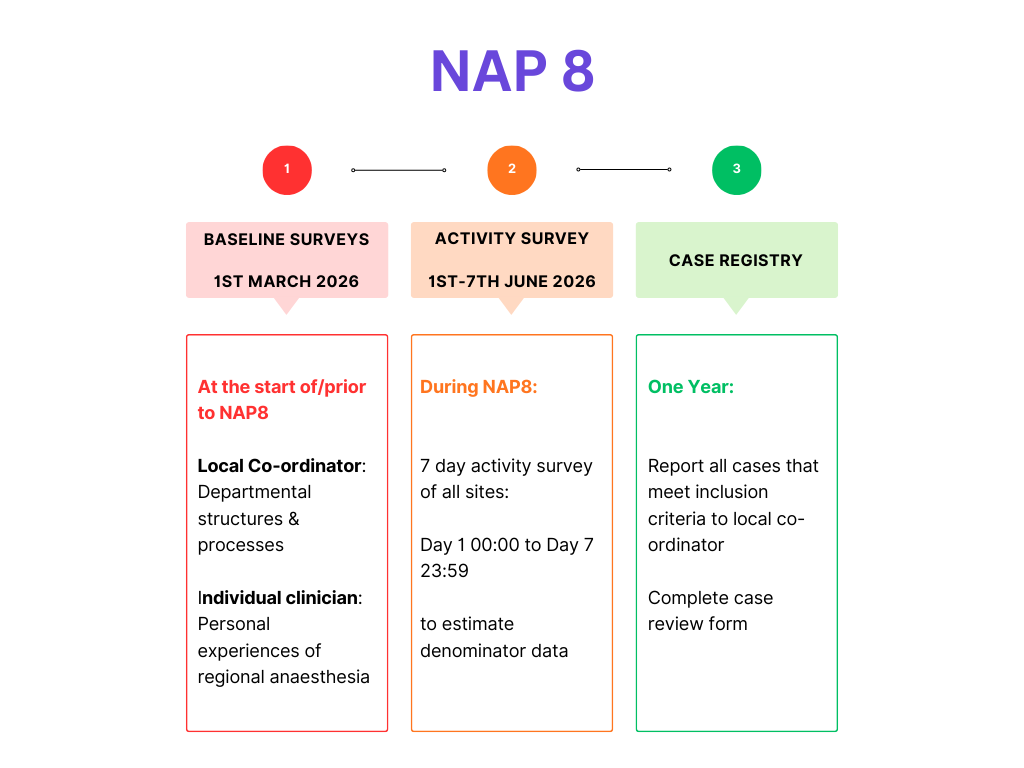
RCEM NAP8 consists of three main stages
- An initial baseline survey:
- To capture clinicians’ professional experience of regional anaesthesia
- To capture departmental structure and processes for regional anaesthesia;
- A seven-day activity survey at each site to measure overall procedural activity and gather denominator data.
- A one-year case registry in which all major complications related to peripheral nerve blocks performed in the ED are anonymously reported; and
Together, these stages provide a comprehensive picture of current practice, complication rates, and contributing factors across Emergency Departments in the UK and Ireland.
Local Coordinators play a pivotal role in this work, helping to deliver a high-quality audit that will influence clinical practice, enhance patient safety, and support the growing role of EM clinicians in regional anaesthesia.
Dates
Inclusion criteria
This audit includes peripheral regional anaesthetic techniques used in the Emergency Department that involve the targeted blockade of named peripheral nerves, e.g. fascia iliaca blocks, femoral nerve blocks. These procedures typically require anatomical knowledge, training in landmark or ultrasound-guided techniques, and are subject to governance processes such as documentation, consent, and patient monitoring. They are considered important tools in acute pain management.
Exclusion Criteria
The following procedures are excluded from this audit, as they either do not involve nerve-specific targeting, are considered basic or routine, or differ significantly in mechanism:
- Digital nerve blocks
- Ring blocks
- Local infiltration anaesthesia
- Field blocks (e.g., for scalp or abscesses)
- Haematoma blocks — excluded as they involve local infiltration into fracture sites rather than targeted nerve blockade
- Bier’s blocks (IV regional anaesthesia) — excluded due to their distinct technique involving intravenous anaesthetic and a tourniquet, with limited ED application and differing governance requirements
Complications
Baseline Survey
Beginning 1 March 2026 (duration four months).
Individual clinician survey
An online survey for all UK & Irish EM clinicians. This will investigate attitudes, experience and training in regional anaesthesia as well as previous experience of complications of regional anaesthesia. It will take 5-10 minutes to complete and will not require specialist knowledge.
All responses will be anonymous and confidential. Local Co-ordinators (LCs) will be sent a link to the online survey to distribute to all EM clinicians in their department. The survey should be completed by all grades of clinicians working in the ED. After completion of the survey, respondents will be asked to send an email confirming completion to their LC to enable the LC to track who in their department has responded.
LCs will likely appreciate some help and this is a great opportunity to get involved. LCs will be provided with certificates that they can send to colleagues who have completed the survey.
Local Co-ordinator baseline survey
This seeks additional summary data about department size, structure, equipment and preparedness for management of regional anaesthesia complications.
Activity Survey
The activity survey will be carried out during the 12-month registry period (1 June – 7 June 2026). It will serve two purposes:
- Create a quantitative snapshot of activity in the UK & Ireland. This will be used to calculate denominator data for NAP8.
- Collect details pertinent to regional anaesthesia and complications. This will help develop a more detailed understanding of regional anaesthesia practice across the UK & Ireland as well as collecting specific patient and procedural risk factors that are relevant to the complications collected during the registry phase.
Each hospital site will be asked to survey on seven consecutive days. LCs will be asked to facilitate this survey in their ED to ensure that the department is aware of the survey and to check that all patients have a completed survey form.
One activity survey entry will be completed by the clinician for each interventional procedure during the survey period at each site using an electronic form. A link will be sent to the survey and each case will be recorded by completing the survey. We strongly advise that individual clinicians complete the link themselves as soon after the case as practically possible.
The case registry will provide information about the occurrence, management and outcomes of all major complications of regional anaesthesia administered in the ED. The case registry phase will last for one year. After the one-year case registry period has ended the reporting system will remain open for 2 months to allow for the completion of data entry.
Please note that this does not replace your standard reporting procedures used for adverse events. Cases should be reported as soon as possible after a complication has occurred. This will ensure any details relying on recall are as accurate and complete as possible. Please ensure that local procedures are followed to formally report the complication, NAP 8 does not replace this.

Get Involved in NAP8: Opportunities for ED Teams
NAP8 offers a range of opportunities for colleagues across the Emergency Department to take part in an important national project. Each site will have a local coordinator, see the Local Coordinator Pack in the resources tab for more details. Check our list to see if your ED has a Local Coordinator.
Interested in Becoming a Local Coordinator?
Please email nap8@rcem.ac.uk and Cc your departmental medical lead (e.g. Clinical Lead, Clinical Director, QI Lead) so they are aware and can provide oversight.
The role is open to:
- SAS doctors
- Doctors on the CESR route
- EM trainees
- Advanced Clinical Practitioners (ACPs)
- Consultants
Coordination should take place with the awareness and support of the relevant medical lead in your department.
Professional development
- RCEM SLO evidence for EM trainees
- CESR portfolio evidence
- SAS development objectives
- Advanced practice competencies
- Appraisal and revalidation evidence for consultants
Leadership experience
- Lead local delivery of a national project
- Support survey uptake and case reporting
- Liaise with your medical lead and the central NAP8 team
Impact and recognition
- Contribute to a high-profile national project examining regional anaesthesia in ED
- Recognised as a citable collaborator under the RCEM NAP8 SLWG
- Act as the main contact for NAP8 in your ED
- Coordinate the baseline survey
- Support case identification and reporting
- Promote engagement with the activity survey
- Liaise with your department’s medical lead and the NAP8 central team
- Issue certificates of participation to ED colleagues who support NAP8 activity locally.
You don’t need to be a Local Coordinator to contribute. All members of the ED team can take part, including:
- All resident doctors working in the ED
- SAS and CESR doctors
- ACPs, ENPs/ANPs
- Consultants
- Nursing staff and other clinicians
Ways to get involved:
- Completing the baseline survey
- Assisting with case identification or reporting
- Supporting the activity survey
- Participating in local QI and governance discussions
Benefits of contributing:
- Portfolio evidence for trainees, CESR candidates, and ACPs
- QI, audit and governance experience
- Appraisal and revalidation evidence for consultants
- Experience in a nationally coordinated EM project
Certificates of participation can be issued by the Local Coordinator to recognise team contributions.